
Cost to Spray Paint Oak Kitchen UK: 2026 Price & Transformation Guide
That solid oak kitchen cost a fortune to install, yet here you are, staring at cabinets that look more like a 1990s pub than the modern home you actually want. You’re not alone. Thousands of UK homeowners are sitting on structurally sound, beautifully built oak kitchens that simply need a fresh identity, not a skip lorry and a five-figure bill. If you’ve been searching for the cost to spray paint an oak kitchen in the UK, you’ve probably already sensed that a full replacement feels like an expensive overreaction to a purely aesthetic problem. You’re right to question it.
Professional kitchen respraying is one of the most underused transformations in the home improvement world, and the confusion around grain visibility, finish durability, and what separates a specialist respray from a DIY brush job puts many homeowners off before they’ve even explored their options. This guide cuts through all of that. You’ll find a clear breakdown of what drives the cost, what the process actually involves, and why an automotive-grade spray finish preserves the value of your solid oak whilst delivering results that hand-painting simply cannot match.
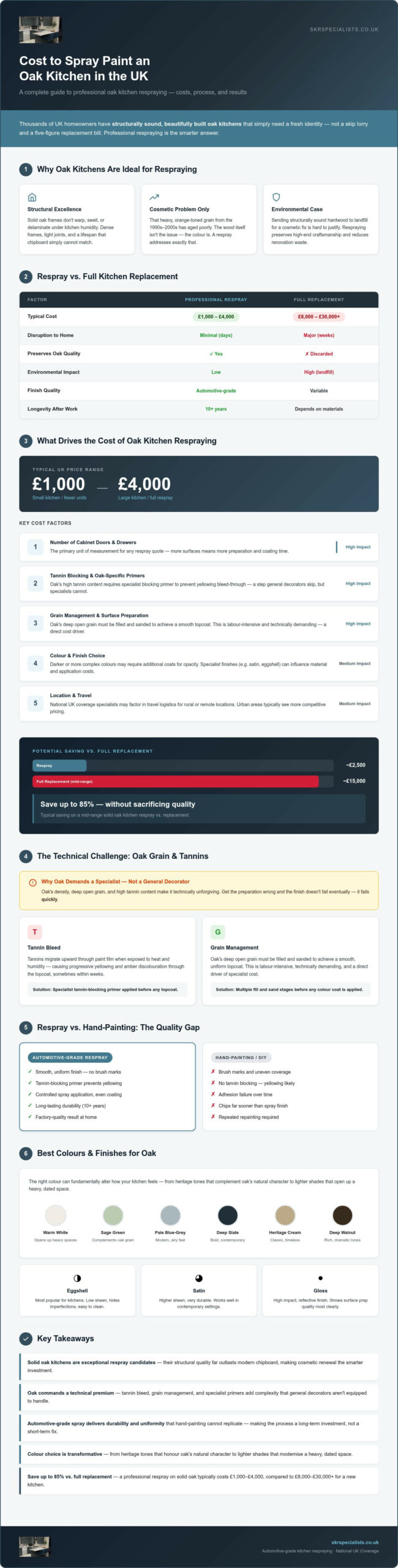
Key Takeaways
- Solid oak kitchens are exceptional candidates for professional respraying because their structural quality far outlasts modern chipboard alternatives — meaning a cosmetic refresh is nearly always the smarter investment.
- Understanding the cost to spray paint an oak kitchen in the UK requires knowing why oak commands a premium: tannin bleed, grain management, and specialist primers all add technical complexity that general decorators simply aren’t equipped to handle.
- The right colour choice can fundamentally alter how your kitchen feels — from heritage tones that complement oak’s natural character to lighter shades that open up a heavy, dated space.
- An automotive-grade spray finish delivers a level of durability and uniformity that hand-painting cannot replicate, making the process a long-term investment rather than a short-term fix.
- SKR Specialists bring a high-precision background in automotive paint finishing to every kitchen transformation, with national UK coverage that makes a factory-quality result accessible wherever you are.
Why Oak Kitchens are Ideal Candidates for Professional Respraying
Professional oak respraying isn’t simply a coat of paint applied by someone with a spray gun. It’s a specialist surface restoration process that combines substrate preparation, tannin management, and automotive-grade finishing techniques to deliver a result that’s built to last. The distinction matters enormously when you’re dealing with a material as characterful and demanding as solid oak.
Most homeowners researching the cost to spray paint an oak kitchen in the UK are working with kitchens that are structurally exceptional. Solid oak cabinetry, particularly anything installed before flat-pack alternatives dominated the market, was built to endure. The frames are dense, the joints are tight, and the material itself has a lifespan that modern chipboard or MDF simply cannot match. Replacing a solid oak kitchen with budget flat-pack units isn’t an upgrade; it’s a downgrade dressed up in new doors.
While respraying is an excellent way to preserve quality cabinetry, if you are considering a complete layout change or a brand-new luxury installation, you may wish to visit Broadway Kitchens to see how bespoke kitchens are still manufactured to these high standards.
There’s an environmental argument here too. Sending structurally sound hardwood to landfill to solve a purely cosmetic problem is difficult to justify when a professional respray can transform the same cabinets into something that looks entirely contemporary. Choosing to renew rather than replace is one of the most straightforward ways a homeowner can reduce the environmental footprint of a renovation.
The Structural Integrity of Oak
Solid oak frames don’t warp, swell, or delaminate the way budget alternatives do when exposed to kitchen humidity over time. That structural resilience is precisely what makes them worth investing in. A factory-quality respray applied to well-built oak cabinetry can deliver another decade or more of daily use, at a fraction of the cost of replacement. This is upcycling in its most practical form: preserving high-end craftsmanship whilst giving it a completely modern identity.
The aesthetic problem most homeowners want to solve is familiar. That heavy, orange-toned grain that defined kitchens throughout the 1990s and early 2000s has aged poorly against contemporary interior tastes. The wood itself isn’t the issue. The colour is. A professional respray addresses exactly that.
Respray vs. Hand-Painting: The Quality Gap
Hand-painting oak leaves brush marks, uneven coverage, and a finish that chips far sooner than it should. Oak is also a tannin-rich wood, meaning untreated surfaces bleed discolouration through standard paints over time, causing yellowing and adhesion failure. These aren’t problems that careful brushwork can solve; they require specialist primers and controlled spray application.
An automotive-grade spray finish produces a smooth, uniform surface that hand-painting simply can’t replicate. If you’re weighing up your options, it’s worth understanding the durability of kitchen cabinet spraying in detail before making any decisions. The quality gap between a specialist respray and a DIY paint job isn’t marginal. It’s transformative.
The Technical Challenge: Managing Oak Grain and Tannins
Oak is one of the most rewarding surfaces to respray. It’s also one of the most demanding. The same properties that make solid oak cabinetry structurally exceptional — its density, its deep open grain, its high tannin content — are precisely the properties that make it technically unforgiving when it comes to surface finishing. Get the preparation wrong, and the finish fails. Not eventually. Quickly.
This is the part of the process that separates a specialist kitchen resprayer from a general decorator with a spray gun. Understanding these technical challenges is also essential context for anyone researching the cost to spray paint an oak kitchen UK, because the additional preparation steps that oak demands are a direct driver of the investment involved.
Tannin Blocking: Preventing the “Yellow Effect”
Tannins are naturally occurring chemical compounds found in high concentrations within oak. When a new coating is applied, heat, humidity, and the natural off-gassing of the wood cause these tannins to migrate upward through the paint film. The result is a progressive yellowing or amber discolouration that appears through the topcoat, often within weeks on an untreated surface.
The solution is a specialist tannin-blocking primer, typically shellac-based or a high-performance water-based isolator, applied as a dedicated barrier coat before any colour is introduced. This primer forms a chemical seal that prevents tannin migration regardless of what the kitchen is exposed to over time. Standard emulsion or gloss applied directly to oak will fail within months, with discolouration appearing no matter how carefully the surface was cleaned beforehand.
Grain Texture: To Fill or Not to Fill?
Oak has a pronounced open grain structure, and how that grain is handled defines the entire character of the finished kitchen. There are two distinct approaches, and neither is universally superior. The right choice depends entirely on the aesthetic you’re working towards.
- Grain-showing finish: The natural texture of the wood remains visible beneath the topcoat, giving the kitchen a tactile, organic quality. This works particularly well with heritage tones, soft whites, and muted greens, where a degree of texture adds warmth rather than feeling unrefined.
- Grain-filled finish: A grain filler is applied and sanded back in stages before priming, creating a smooth, flat surface that reads as almost contemporary lacquer. Darker colours such as navy, charcoal, and slate interact strongly with oak grain, so homeowners choosing these shades typically prefer the cleaner result that grain filling delivers.
Neither approach shortcuts the preparation stage. Both require thorough, multi-stage degreasing of the cabinet surfaces before any product is applied. Older oak kitchens accumulate years of cooking residue, wax, and cleaning product build-up deep within the grain. A single wipe-down isn’t sufficient. Professional preparation involves a systematic degreasing process using appropriate solvents to strip the surface back to a chemically clean substrate, ensuring adhesion is consistent across every panel.
Skipping or rushing any of these stages is where most failed kitchen respray jobs originate. If you’d like to understand how a properly executed process translates into a finish that genuinely lasts, SKR Specialists’ guide to kitchen cabinet spraying durability covers the long-term performance expectations in detail.
Calculating the Cost to Spray Paint an Oak Kitchen in 2026
Most online pricing guides quote a flat per-cabinet figure and leave it there. That approach fails oak kitchen owners almost immediately, because oak respraying carries a genuine premium over laminate or MDF work, and understanding why that premium exists is what allows you to evaluate a quote properly rather than simply comparing headline numbers.
The additional cost to spray paint an oak kitchen in the UK versus a standard laminate kitchen comes directly from the preparation stages covered earlier in this guide: tannin-blocking primers, multi-stage degreasing, and grain management decisions all add labour time before a single coat of colour is applied. A general decorator pricing a laminate kitchen won’t carry those material costs or that process overhead. An oak specialist will, and the difference in the finished result justifies every penny of it.
As a general guide, UK homeowners can expect the following investment ranges for a professional oak kitchen respray in 2026:
- Small kitchen (up to 10 cabinet doors): typically in the lower range of the market, suited to galley or compact layouts
- Medium kitchen (10 to 20 cabinet doors): the most common project size, covering a standard family kitchen with a mix of wall and base units
- Large kitchen (20+ doors, plus island): premium pricing applies, particularly where end panels, cornices, plinths, and decorative mouldings are included in the scope
For accurate figures specific to your kitchen, requesting a direct quote from a specialist is always the right approach. Pricing varies by location, kitchen complexity, and the condition of the existing finish.
Key Factors Influencing Your Quote
Cabinet count is the starting point, but it’s rarely the whole story. Door profile complexity matters significantly: a Shaker-style door with its recessed centre panel requires more careful spray technique and drying time than a flat-panel contemporary door. The condition of the existing finish is equally important. Oak kitchens carrying layers of wax, varnish, or oil require more intensive preparation to achieve clean adhesion. Fixed structural elements such as end panels, exposed carcass sides, cornices, and plinths all add to the scope. On-site versus off-site spraying requirements for fixed components also influence the final figure, since carcasses that can’t be removed require careful masking and controlled on-site conditions.
Cost Comparison: Respray vs. Wrap vs. Replace
Placing the cost to spray paint an oak kitchen UK into context against the alternatives makes the investment case clear. The table below summarises the three main options available to homeowners with dated oak cabinetry:
| Option | Typical Cost Range | Finish Quality | Durability | Best Suited For |
|---|---|---|---|---|
| Professional Respray | Fraction of replacement cost | Factory-grade, smooth and uniform | Long-term with correct preparation | Structurally sound oak cabinetry |
| Vinyl Wrapping | Mid-range | Variable; edges and corners vulnerable | Medium-term; prone to lifting over time | Flat-panel doors only |
| Full Replacement | £15,000 or more for solid oak | New, but often lower material quality | Dependent on new material specification | Structural failure or complete layout change |
Wrapping presents particular limitations on profiled oak doors. Vinyl struggles to conform cleanly to Shaker mouldings and decorative edges, making it a poor match for the very kitchen styles most homeowners want to refresh. For a detailed breakdown of how these two approaches compare across every practical consideration, the kitchen spray painting vs wrapping guide covers the full picture.
For homeowners planning to sell, the return on investment calculation is straightforward. A kitchen that presents as dated and heavily grained will suppress buyer confidence and perceived property value. A professionally resprayed kitchen, delivered at a fraction of replacement cost, removes that objection entirely. It’s one of the highest-impact pre-sale improvements available to UK homeowners with solid oak cabinetry.
In instances where the existing cabinetry is beyond saving or the layout is no longer suitable, homeowners in London and Surrey may find that investing in a bespoke new installation from Top Notch Kitchen & Bedrooms is the most effective way to add lasting value to their property.
Aesthetic Choices: Best Colours and Finishes for Oak
Colour selection is where a technically excellent respray becomes a genuinely transformative one. The preparation work described earlier in this guide creates the conditions for a flawless finish; the colour you choose determines whether that finish simply updates your kitchen or completely reimagines it. Getting this decision right is worth real thought, particularly given how dramatically interior colour trends have shifted since most oak kitchens were originally installed.
Trending 2026 Kitchen Colours
The neutrals-only approach that dominated kitchen design for most of the 2010s is giving way to something considerably more considered. Earth tones are leading the shift: warm terracottas, dusty clays, and muted ochres that work with oak’s natural warmth rather than fighting it. Deep forest greens are equally strong in 2026, particularly sage and hunter shades that bring a grounded, almost botanical quality to solid wood cabinetry. These aren’t passing trends; they reflect a broader move in British interiors towards materials and colours that feel rooted and enduring.
For kitchens that lack natural light, off-whites remain the most reliable choice. Shades such as warm cream, aged linen, and soft stone reflect available light without the clinical coldness of pure white, making a previously heavy, windowless oak kitchen feel genuinely more spacious. The orange grain that made the original finish feel oppressive simply disappears beneath a well-applied off-white, and the structural quality of the oak beneath reads as warmth rather than weight.
Two-tone kitchens are also firmly established in 2026 rather than emerging. A deep charcoal or forest green island paired with lighter wall units in a complementary off-white or sage creates visual hierarchy without requiring any structural changes. It’s one of the most effective ways to add design sophistication to an existing layout, and solid oak handles the contrast particularly well given its consistent grain character across both tones.
Sheen Levels and Light Reflection
Sheen level is a decision that affects how the kitchen performs daily, not just how it looks in photographs. A 10% matt finish reads as contemporary and understated, absorbing light rather than reflecting it and lending a softer, more matte quality to the colour beneath. It suits heritage tones and earth shades especially well. A 30% satin finish offers a gentle sheen that makes colours appear slightly richer and is somewhat easier to wipe down in high-traffic areas, though it does show fingerprints more readily than matt on darker shades.
Sprayed surfaces reflect light far more uniformly than hand-painted ones, which means sheen level choices land exactly as intended rather than varying panel to panel.
One practical consideration worth raising when you’re thinking about the cost to spray paint an oak kitchen UK: if your kitchen includes an existing oak worktop, coordinate your cabinet colour against it rather than treating them as separate decisions. Warm undertones in the worktop pair naturally with earth tones and off-whites; cooler grey-toned oak suits sage, slate, and muted blue-greens. Getting this pairing right at the colour selection stage avoids a result that feels disjointed once the work is complete.
If you’d like guidance on colour selection specific to your kitchen layout and lighting, speak to the SKR Specialists team before committing to a shade. The right colour choice, applied with an automotive-grade finish, is what turns a dated oak kitchen into something genuinely worth showing off.
Why Choose SKR Specialists for Your Oak Transformation?
Most kitchen resprayers are general decorators who’ve added a spray gun to their toolkit. SKR Specialists come from an entirely different discipline. Our background is in automotive paint finishing, a trade where surface preparation tolerances, coating chemistry, and finish consistency are held to standards that domestic decorating simply doesn’t demand. That precision transfers directly to every oak kitchen we work on, and it’s the reason our results look and perform the way they do.
We operate across the UK, which means the same factory-grade process is available to homeowners in Edinburgh, Bristol, Manchester, or anywhere in between. There’s no regional compromise on materials, technique, or finish quality. Wherever you are, you’re getting the same specialist approach.
Disruption is a genuine concern for most homeowners, and it’s one we take seriously. A typical oak kitchen respray with SKR Specialists is completed in days, not weeks. Your kitchen remains functional throughout the process, and our working methods are designed to keep dust, overspray, and mess contained from the first day to the last.
The SKR Specialist Process
Every project follows a structured, multi-stage process that doesn’t cut corners at any point:
- Degreasing: A systematic, solvent-based clean that strips cooking residue, wax, and surface contamination from deep within the oak grain, creating a chemically clean substrate.
- Masking: Worktops, appliances, flooring, and adjacent surfaces are fully protected before any product is applied. Your home stays clean.
- Tannin-blocking primer: A specialist barrier coat is applied to prevent the oak’s natural tannins from migrating through the topcoat and causing discolouration over time.
- Multi-coat spraying: Professional-grade, hard-wearing lacquers are applied in controlled coats, building a finish that’s smooth, uniform, and built to withstand daily kitchen use.
The lacquers we use aren’t trade-counter products. They’re the same calibre of coating used in precision automotive finishing, which is why the durability of an SKR respray consistently outperforms anything a local decorator can deliver with a brush or a basic spray setup. When you’re weighing up the cost to spray paint an oak kitchen UK, that performance gap is a significant part of what you’re investing in.
Book Your 2026 Kitchen Transformation
Getting an accurate quote doesn’t require a site visit upfront. Send us photographs of your kitchen and we’ll provide an immediate, detailed digital quote based on what we can see. It’s a straightforward process designed to give you real numbers without unnecessary back-and-forth.
Our national booking system is built around your schedule, not ours. If you’re ready to stop looking at a kitchen that no longer reflects how you want your home to feel, the next step is simple. Get your free kitchen respray quote from SKR Specialists today and find out exactly what your oak kitchen transformation will cost in 2026.
Your Oak Kitchen Deserves Better Than a Skip Lorry
Solid oak cabinetry is worth preserving. The structural quality beneath that dated finish represents craftsmanship that modern flat-pack simply can’t replicate, and the cost to spray paint an oak kitchen UK delivers that preservation at a fraction of what full replacement demands. Tannin management, grain preparation, and automotive-grade lacquers aren’t details you’d get from a general decorator; they’re the difference between a finish that lasts and one that fails within a season.
Three things stand out from everything covered in this guide: oak respraying is a technically specialist process, colour choice is as important as preparation, and the quality of the applicator determines the longevity of the result. Get those three things right and you have a kitchen that looks genuinely contemporary for years to come.
SKR Specialists bring automotive precision, national UK coverage, and a proven process to every oak kitchen they transform. Don’t settle for a kitchen that no longer reflects how you want your home to feel. Get your free oak kitchen respray quote from SKR Specialists today and take the first step towards a result you’ll actually be proud of.
Frequently Asked Questions About Spraying Oak Kitchens in the UK
How much does it cost to spray paint a standard oak kitchen in the UK?
The cost to spray paint an oak kitchen UK varies depending on cabinet count, door profile complexity, and the condition of the existing finish. Oak commands a genuine premium over laminate or MDF work because of the additional preparation stages involved, including tannin-blocking primers and multi-stage degreasing. Rather than quoting figures that won’t reflect your specific kitchen, the most reliable approach is to send photographs to a specialist for an accurate digital quote.
Can you still see the wood grain after spraying oak cabinets?
That’s entirely your choice. A grain-showing finish preserves the natural texture of the oak beneath the topcoat, which works beautifully with heritage tones and softer colours. A grain-filled finish involves applying and sanding back a filler in stages before priming, producing a smooth, almost lacquer-like surface that suits darker shades such as navy or charcoal particularly well. A specialist will discuss both options with you before any product is applied.
How long does a professional oak kitchen respray last?
A professionally applied respray using automotive-grade lacquers, combined with correct tannin-blocking preparation, is built for long-term daily use. The durability of the finish depends heavily on the preparation stages rather than the topcoat alone; surfaces that haven’t been properly degreased and primed will fail far sooner regardless of product quality. When the process is executed correctly, homeowners can expect a finish that performs consistently for years without peeling, yellowing, or chipping under normal kitchen conditions.
Do I need to empty my cupboards before the sprayers arrive?
Generally, no. The respraying process focuses on external cabinet doors, drawer fronts, and visible surfaces rather than the interior of the units. Your crockery, food, and stored items can stay where they are throughout the project. It’s sensible to clear the immediate countertop area to give the team clean access, but there’s no need to strip out the entire kitchen before work begins.
Is it better to spray or hand-paint oak kitchen units?
Spraying is significantly superior for oak. Hand-painting leaves brush marks, produces uneven coverage across the grain, and delivers a finish that chips and wears far sooner than a sprayed equivalent. Oak’s open grain structure also makes consistent coverage with a brush genuinely difficult to achieve. An automotive-grade spray finish produces a smooth, uniform result across every panel, which is simply not replicable with a brush regardless of the painter’s skill level.
Will the paint peel off my oak doors over time?
Peeling is almost always a preparation failure rather than a product failure. The most common cause is inadequate degreasing before priming; older oak kitchens carry years of cooking residue and wax deep within the grain, and if that contamination isn’t fully removed, adhesion fails. A specialist tannin-blocking primer applied to a chemically clean substrate is what prevents both peeling and the yellowing discolouration that untreated oak surfaces produce through standard coatings.
How long does the kitchen respray process take from start to finish?
A typical oak kitchen respray with SKR Specialists is completed in days rather than weeks. The exact duration depends on kitchen size, the number of doors and panels in scope, and whether grain filling is part of the specification. Critically, your kitchen remains functional throughout the process. The working methods are designed to keep disruption contained, so you’re not left without a kitchen for an extended period whilst the transformation takes place.
Can you change the handles and hinges as part of the respray service?
Handle and hinge replacement isn’t part of the kitchen unit respray service SKR Specialists provide, but it’s a straightforward addition you can arrange independently before or after the respray is complete. New hardware is one of the most cost-effective ways to reinforce the fresh identity the respray delivers, and fitting it after the finish has fully cured ensures the new handles sit cleanly against an unblemished surface. Your specialist can advise on timing if you’re planning to combine both updates.