
Kitchen Spray Painting vs Wrapping: The Ultimate 2026 Comparison Guide
Would you trust a thin layer of adhesive plastic to survive the intense heat of your oven or the relentless steam from your kettle for the next decade? Many homeowners find themselves at this exact crossroads when debating kitchen spray painting vs wrapping, caught between the lure of a quick fix and the desire for a permanent transformation. We understand the hesitation; nobody wants to invest their hard-earned money only to see edges peeling or a “DIY look” emerge within months.
You deserve a kitchen that looks brand new without the disruption of a full structural remodel. This guide promises to clarify the confusion, showing you why a professional factory-grade respray offers a superior, more durable finish that outclasses vinyl film. We’ll explore the critical differences in heat resistance, cleaning ease, and long-term value. By the end, you’ll know exactly how to achieve a flawless, easy-to-clean surface that is designed to last 10 years or more, giving you the quiet confidence of a truly expert finish.
Key Takeaways
- Learn why industrial-grade lacquer and chemical bonding create a permanent architectural restoration rather than a temporary adhesive cover.
- Compare the technical durability of kitchen spray painting vs wrapping to see why professional spraying withstands steam and heat where adhesives often fail.
- Discover how to achieve a flawless factory finish with unlimited colour matching, avoiding the “orange peel” texture common with budget vinyl films.
- Evaluate the long-term financial value of a professional respray that lasts over a decade, preventing the “false economy” of frequent replacements.
- Identify the meticulous preparation and automotive-grade equipment necessary to ensure a smooth, dust-free result that looks brand new.
Understanding the Difference: Kitchen Spray Painting vs Wrapping in 2026
The UK home renovation market has undergone a significant shift towards high-end refurbishment. Property owners are increasingly rejecting the “rip out and replace” mentality in favour of more sustainable, value-driven alternatives. When you evaluate kitchen spray painting vs wrapping, you’re deciding on the long-term resilience of your kitchen’s surfaces. Professional spray painting is the application of industrial-grade lacquer that creates a hard-wearing, factory-standard finish. Wrapping, however, is a temporary aesthetic fix involving PVC vinyl film with an adhesive backing. This choice dictates whether your kitchen looks pristine for two years or stays beautiful for over ten.
The Core Mechanism: Coating vs Covering
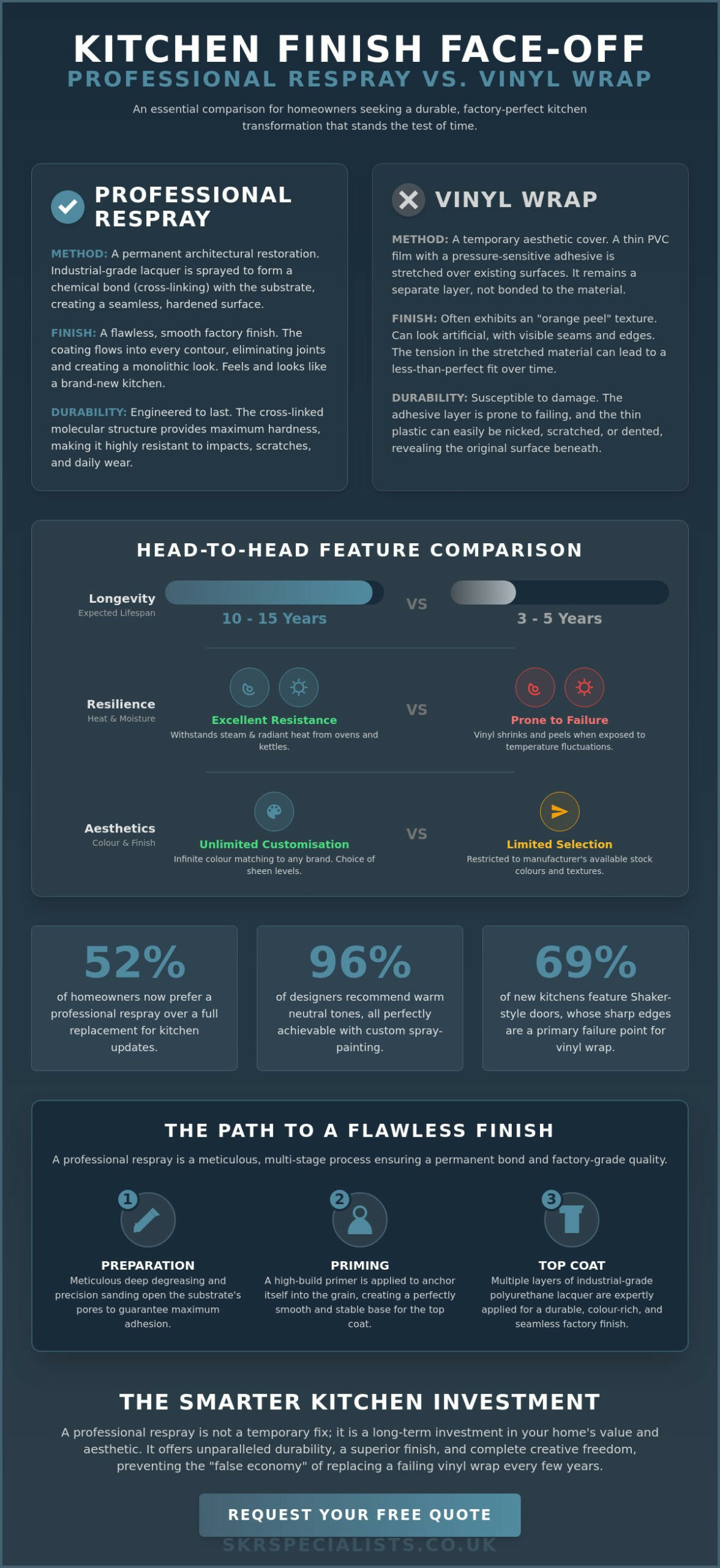
Professional spraying is a sophisticated coating process that results in a permanent architectural restoration. By utilising advanced spray painting techniques, we ensure the lacquer flows into every contour of your cabinetry. This creates a seamless barrier against moisture and heat. Wrapping relies on stretching a flat sheet of vinyl over three-dimensional doors. This process introduces physical tension into the material. Because vinyl possesses “material memory,” it constantly tries to shrink back to its original flat state. In a high-moisture environment, this tension often leads to unsightly lifting at the edges, particularly on the slim Shaker profiles that 69% of designers now favour. Furthermore, spraying allows for total customisation in colour, including the warm neutrals like mushroom and taupe that 96% of designers currently recommend.
Why Homeowners are Moving Away from Full Replacements
A kitchen respray is now the preferred choice for 52% of homeowners undergoing updates, according to 2026 Houzz survey data. The reasons are both environmental and financial. Refurbishing existing units prevents tonnes of cabinetry from entering UK landfills, aligning with modern eco-conscious values. The speed of the process is another major factor. A full refit can leave you without a functioning kitchen for weeks, involving plumbers, electricians, and fitters. Our specialised respray process typically takes only a few days, minimising disruption whilst providing a finish that is indistinguishable from brand-new units. It’s a disciplined, no-nonsense solution that bypasses the high costs and stress of structural remodelling, allowing you to invest in high-quality finishes rather than just new carcasses.
Durability and Longevity: The Science of the Permanent Bond
The longevity of your kitchen depends entirely on the molecular relationship between the finish and the surface underneath. In the debate of kitchen spray painting vs wrapping, the winner is decided by how the materials react to the daily rigours of a busy household. Professional spray painting doesn’t just sit on top of the wood; it undergoes a process called cross-linking. When we apply industrial-grade polyurethane lacquers, a chemical reaction occurs that creates a tight, three-dimensional network of molecules. This results in a surface with maximum hardness and incredible resistance to impact.
A high-quality finish is only as good as the groundwork. The Science of the Permanent Bond relies on meticulous preparation that general trade practitioners often overlook. We begin with deep degreasing and precision sanding to open the pores of the substrate. This ensures the primer doesn’t just stick; it anchors itself into the grain. Vinyl wrapping, by contrast, relies on a pressure-sensitive adhesive. Because there is no chemical fusion, the vinyl remains a separate layer. Over time, this leads to “delamination,” where the edges inevitably lift as the adhesive dries out or weakens. Whilst a professional respray is designed to look pristine for 10 to 15 years, many wraps begin to fail within 3 to 5 years.
Heat and Moisture: The Enemies of Vinyl
Kitchens are volatile environments. The steam from your kettle and the radiant heat from your oven are the primary causes of vinyl failure. When exposed to temperature fluctuations, PVC vinyl experiences a “shrinkage” effect. The material tries to return to its original form, causing it to pull away from corners and recessed panels. We often see wrapped kitchens where the vinyl has shrivelled near the cooker. You might wonder, is kitchen cabinet spraying durable enough to handle these conditions? The answer lies in its heat-resistant properties. Once cured, our lacquers remain stable and won’t melt, peel, or shift when things get hot.
Maintenance and Repairability
Life happens, and even the toughest surfaces can face accidents. If you chip a sprayed door, the repair is straightforward. Because it’s a liquid-applied coating, we can perform invisible touch-ups that blend perfectly with the surrounding area. If you tear or puncture a vinyl wrap, there is no way to “patch” the hole. The entire door must be stripped and re-wrapped, which often leads to colour-matching issues if the vinyl batch has changed. Our lacquers also offer superior chemical resistance. You can wipe away grease and spills without worrying about dissolving the finish, unlike PVC which can be sensitive to certain household cleaners. If you’re ready to upgrade to a surface that truly lasts, you can explore our kitchen unit respray services to see the difference for yourself.
Aesthetic Flexibility and Finish Quality: Achieving the Factory Look
When you evaluate kitchen spray painting vs wrapping, the visual result is often the deciding factor for property owners seeking a high-end restoration. There is a fundamental difference between a surface that has been coated and one that has been covered. Vinyl wraps often suffer from what industry professionals call the “Orange Peel” effect. This is a subtle, bumpy texture caused by the adhesive layer underneath the plastic film. It lacks the depth and clarity of a genuine finish, often leaving the kitchen looking like it has been “stickered” rather than renovated.
Professional spraying uses atomised industrial lacquer to achieve a glass-smooth surface that is indistinguishable from a factory-new unit. This method preserves the authentic character of your cabinetry. If your doors have a beautiful natural grain, our specialised lacquers will enhance it rather than masking it under a layer of PVC. Colour matching is another area where spraying offers total freedom. Whilst vinyl installers are limited to a specific catalogue of manufactured films, we can mix our coatings to match any shade from Farrow & Ball, Little Greene, or the RAL colour chart. This ensures your kitchen perfectly complements your interior design vision without compromise.
The Limitations of Vinyl Contouring
The rise of modern kitchen design has seen a 69% increase in the popularity of flat slab and slim Shaker-style doors for 2026. These designs often feature tight internal corners and intricate grooves that are a nightmare for wrapping specialists. Because vinyl is a physical sheet, it struggle to adhere to deep recesses. This leads to “bridging,” where the material spans across a gap rather than sitting flush within it. Our spray painting process flows naturally into every crevice. It provides uniform colour saturation across the entire door, ensuring no awkward gaps or white edges are visible when you open a cupboard.
Choosing Your Sheen: Matt, Satin, or Gloss
The trend for 2026 has moved decisively away from high-gloss plastics towards more sophisticated, low-sheen finishes. Satin is currently the most popular choice, accounting for 65% of the market, whilst “Super Matt” finishes have seen a 25% surge in demand. These low-sheen options are favoured because they are more resistant to fingerprints and smudges, making them ideal for busy households. Light reflects differently on a sprayed surface; it appears soft and diffused rather than harsh and artificial. Because of this superior light behaviour and the ability to achieve a flawless, dust-free result, professional spraying is the best alternative to replacing kitchen cabinets for homeowners who refuse to settle for a second-rate aesthetic.
Calculating the Real Cost: Short-term Savings vs Long-term Value
The initial price tag of a kitchen renovation often masks the true cost of ownership. When you compare kitchen spray painting vs wrapping, it’s easy to fall into the trap of “false economy.” Whilst a vinyl wrap might save you £500 on the initial invoice, a material that peels near your kettle within three years will eventually cost you more. You’ll face the expense of stripping the failed film and redoing the work properly. Professional spraying is a smarter investment because it eliminates the need for these repeated, costly interventions.
Labour dynamics play a significant role in the final price of your project. Wrapping is an incredibly labour-intensive process that requires technicians to hand-cut, stretch, and heat-shrink every individual door. This manual approach is slow and prone to human error. In contrast, our respray service is efficiency-driven. By utilising automotive-grade spray equipment, we achieve a superior finish in a fraction of the time. This technical precision allows us to deliver a luxury result without the inflated labour costs associated with manual vinyl installation. The average kitchen respray cost typically represents only a small fraction of the price of a full kitchen replacement, often saving homeowners up to 80% compared to buying new units.
From a property value perspective, UK estate agents consistently favour sprayed kitchens over wrapped ones. A wrapped kitchen can feel like a temporary mask, which savvy buyers often view as a potential maintenance headache. A professional respray presents as a permanent factory finish that looks and feels like a brand-new kitchen. This “luxury” aesthetic directly supports a higher asking price and helps properties stand out in a competitive market. It’s a disciplined way to add genuine value to your home without the stress of a full refit.
The 10-Year Cost Projection
Think about the next decade of your home life. Over ten years, you’ll likely need three separate vinyl wrap applications to keep the kitchen looking decent as edges lift and colours fade. A single professional spray job will easily outlast this period with minimal maintenance. When you factor in the “hassle cost” of having your kitchen disrupted multiple times, the value of a permanent coating becomes undeniable. Securing a detailed kitchen cabinet respray quote allows you to budget accurately for a one-time transformation that stands the test of time.
Commercial vs Residential Considerations
Landlords are increasingly turning to spraying for its “tenant-proof” durability. In rental properties, surfaces must withstand heavy use and frequent cleaning; vinyl simply isn’t up to the task. For homeowners, the “refresh” factor is vital for a quick sale. A sprayed kitchen provides that “new home” feel that captures a buyer’s imagination immediately. If you want to maximise your property’s potential and ensure your investment delivers the highest return, you can book a professional kitchen unit respray to secure a finish that lasts.
Why Professional Respraying is the Smarter Kitchen Investment
Choosing between kitchen spray painting vs wrapping is ultimately a choice between the calibre of an expert craftsman and the limitations of a vinyl installer. A vinyl installer is essentially a technician applying a temporary adhesive cover. Our team at SKR Specialists operates with the meticulous discipline of specialized practitioners. We bring a background in high-precision technical trades to every project, ensuring a level of detail that general domestic services simply cannot replicate. By utilising automotive-grade spray equipment in a controlled environment, we achieve a flawless, dust-free finish that is impossible to match with manual adhesive films.
The final verdict for any property owner seeking a permanent transformation is clear. Professional spraying is the only logical choice for those who value longevity, heat resistance, and a genuine factory-standard aesthetic. It represents a permanent architectural restoration rather than a temporary mask. We bridge the gap between technical precision and home aesthetics, ensuring your surfaces don’t just look better; they perform better for a decade or more. This no-nonsense approach to refurbishment has disrupted the traditional kitchen industry, proving that you don’t need a total replacement to achieve a high-end, modern result.
The SKR Specialists Difference
Our commitment to excellence means we refuse to offer wrapping services. We’ve seen too many failed vinyl projects where heat from a simple kettle has caused irreversible delamination. Our background in high-precision trades allows us to apply a level of craftsmanship that treats your kitchen as a high-value asset. We focus on the metaphor of renewal; we don’t just paint cupboards, we restore the heart of your home. This disciplined process turns tired, dated units into modern masterpieces that stand up to the rigours of 2026 living whilst maintaining their superlative aesthetic value.
Next Steps for Your Kitchen Transformation
Starting your journey is a seamless, digital-first experience. You don’t need to wait for a site visit to understand the value we provide. Simply provide digital photos of your current kitchen units, and we can offer an immediate, accurate estimate based on your specific layout. Our on-site process is fast and efficient, designed to minimise disruption to your daily life whilst delivering an elite result that lasts. Stop settling for a kitchen that looks its age and choose a finish that reflects your standards. Get your professional kitchen respray quote today and discover the transformative power of expert craftsmanship.
Secure a Lasting Transformation for Your Kitchen
Deciding between kitchen spray painting vs wrapping comes down to the choice between a temporary adhesive cover and a permanent architectural restoration. As we’ve explored, a professional respray offers superior heat resistance and a flawless factory finish that vinyl films simply cannot match. By prioritising industrial-grade lacquers over PVC stickers, you ensure your surfaces remain beautiful and easy to clean for well over a decade.
We bring over 5 years of specialist spraying experience and automotive-grade precision to every home we visit. Our nationwide UK service is designed to be fast, seamless, and transformative. It’s time to move past the anxiety of peeling edges and embrace the quiet confidence of a high-end result. Transform your kitchen with a professional respray—book your free quote today.
Your dream kitchen is closer than you think. Let us help you achieve the meticulous, modern look you deserve through the power of expert craftsmanship.
Frequently Asked Questions
Is kitchen spray painting better than wrapping?
Professional spray painting is superior for homeowners seeking a permanent, factory-standard restoration. Whilst wrapping is a temporary adhesive cover, spraying creates a chemical bond with the substrate that withstands heat and moisture far better. This makes it the disciplined choice for a high-end kitchen transformation that looks and feels like a brand-new installation rather than a masked surface.
Does kitchen wrapping peel off over time?
Vinyl wrapping is prone to delamination, particularly in areas exposed to steam or radiant heat. You’ll often see edges lifting near kettles, toasters, or ovens within a few years of application. Because vinyl possesses material memory, it naturally tries to shrink back to its original flat state, eventually causing the pressure-sensitive adhesive to fail and pull away from corners.
How much does it cost to spray paint a kitchen vs wrap it?
Wrapping generally has a lower initial price point because it uses cheaper materials and less technical equipment. However, when evaluating the total cost of kitchen spray painting vs wrapping over a decade, spraying is the more cost-effective investment. You avoid the repeated expense of replacing failed vinyl every few years, providing much higher long-term value for your property.
Can you spray paint over previously wrapped kitchen doors?
We can respray doors that were previously wrapped, but the old vinyl must be completely stripped first. Spraying directly over vinyl isn’t possible as the industrial lacquer won’t bond to the plastic film. Once the original substrate is revealed and professionally prepared through degreasing and sanding, we can apply our high-performance coating for a permanent, flawless finish.
How long does a sprayed kitchen last compared to a wrap?
A professionally sprayed kitchen typically lasts between 10 and 15 years with normal residential use. In contrast, vinyl wraps often start showing signs of wear or peeling within 3 to 5 years. Our cross-linking polyurethane coatings provide a durable, hard-wearing surface that far outlasts temporary adhesive films, making it a smarter choice for long-term kitchen refurbishment.
Can I change the colour of my kitchen again after it has been sprayed?
You can absolutely respray your kitchen in the future if you decide to update your interior design. Because our finish is a permanent coating rather than a thick plastic layer, it can be sanded and recoated professionally. This flexibility allows you to keep up with evolving trends, such as the 2026 preference for warm neutrals, without the need to replace your cabinetry.
Is there a smell or mess involved with kitchen spray painting?
Our process is designed to be clean and efficient with minimal disruption to your home. We use specialised extraction equipment and thorough masking to protect your surfaces. Whilst there is a slight odour during the application of industrial lacquers, it dissipates quickly once the coating cures. This leaves you with a pristine, dust-free finish and a kitchen that is ready to use.
Which finish is easier to clean, spray or wrap?
Sprayed finishes are significantly easier to maintain because they are chemically resistant and entirely seamless. You can wipe away grease and spills without worrying about moisture getting under an edge or dissolving the adhesive. Vinyl wraps are more sensitive to household cleaners and the edges can trap dirt over time, making them more difficult to keep hygienic and looking sharp.