
Satin vs Matte Finish Kitchen Cabinets: The 2026 Comparison Guide
Recent research indicates that 72% of homeowners prioritise the “wow factor” of their kitchen over practical concerns like greasy thumbprints. It is a common dilemma; you want the sophisticated look of a high-end showroom, but you worry about the reality of sticky fingers and daily wear. Choosing between satin vs matte finish kitchen cabinets is one of the most critical decisions you’ll make during a professional kitchen respray. It is the difference between a surface that glows with a subtle lustre and one that offers a deep, velvety depth.
We know you’re looking for a finish that feels expensive and authentic without looking overly shiny or dated. In this 2026 comparison guide, we’ll help you navigate the technical differences between these two popular sheens to ensure your kitchen remains low-maintenance and durable. You’ll learn about the rising popularity of ultra-matte textures and why a specific 15% “dull satin” might be the perfect middle ground for your home. We’ll show you how to achieve a factory-quality finish that transforms your space into a brighter, more modern heart of the home.
Key Takeaways
- Learn the core visual differences between satin vs matte finish kitchen cabinets to determine whether a non-reflective, velvety look or a silky glow suits your space.
- Discover how skin oils and kitchen degreasers interact with each sheen to ensure your surfaces remain low-maintenance and durable in a busy home.
- Understand how Light Reflectance Value (LRV) affects your room’s atmosphere and why the right choice prevents dark kitchens from feeling “muddy”.
- Identify which finish best complements your specific cabinetry style, whether you have traditional Shaker doors or minimalist, modern flat-slabs.
- Explore why high-precision technical coatings and professional respraying provide a factory-quality result that is superior to standard hand-painting.
Understanding the Aesthetic: Satin vs Matte Finishes Explained
Selecting the right finish is more than a simple choice of colour; it’s a decision on how your kitchen lives and breathes under different light. When comparing satin vs matte finish kitchen cabinets, you’re choosing between two distinct personalities for your home. We’ve found that homeowners often struggle to visualise how these sheens translate from a small sample to a full run of units. Understanding the technical nature of Paint sheen is the first step toward achieving that professional, factory-quality look that defines a high-end respray.
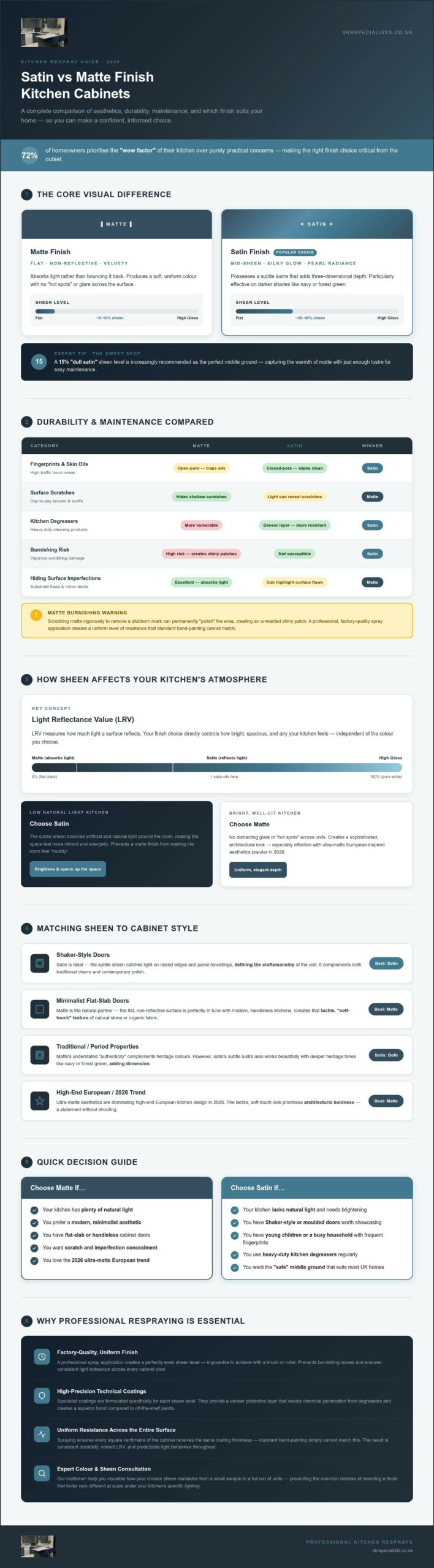
Matte is a non-reflective, flat finish that absorbs light rather than bouncing it back. It provides a soft, velvety appearance that feels incredibly modern and grounded. In contrast, satin is a “mid-sheen” finish. It possesses a slight lustre, often described as a silky glow or a pearl-like radiance. Whilst matte offers an understated “authenticity” often associated with heritage colours and period properties, satin provides a subtle “luxury” factor. It adds a sense of three-dimensional depth, particularly to darker, moodier shades like navy or forest green.
The Visual Impact of Matte Cabinetry
Matte finishes excel at creating a uniform, consistent colour across your entire kitchen. Because the surface doesn’t reflect light, you won’t see the distracting “hot spots” or glare that can occur with glossier sheens. This makes matte an exceptional choice for hiding minor imperfections in the wood or the underlying substrate. For 2026, we’re seeing a significant shift toward “ultra-matte” aesthetics in high-end European kitchen design. This trend prioritises tactile, “soft-touch” textures that feel more like natural stone or organic fabric than traditional paint. It’s a sophisticated, architectural look that makes a bold statement without shouting.
The Subtle Glow of Satin Finishes
Satin remains the “safe” middle ground for many UK homeowners, and for good reason. It provides enough reflection to brighten a room without the harsh, mirrored effect of high gloss. This subtle glow is particularly effective at enhancing the contours and edges of cabinet mouldings. If you have Shaker-style doors or intricate panelling, a satin finish will catch the light on the raised edges, defining the craftsmanship of the unit. Our expert craftsmen often recommend satin for kitchens that lack natural light. The slight sheen helps bounce light around the space, making the room feel more vibrant and energetic. It offers a disciplined balance between traditional charm and contemporary polish.
Practicality in a Busy Home: Durability and Maintenance Comparison
A kitchen is a high-performance workspace, not just a static display. Choosing between satin vs matte finish kitchen cabinets involves weighing up your aesthetic desires against the practical realities of daily life. Whilst both finishes offer a premium feel when applied by a specialist, they behave very differently when faced with the rigours of a busy household. Understanding these physical properties ensures your investment remains as striking as the day it was finished.
The way oils from your skin interact with the surface is a primary concern for many homeowners. Matte finishes possess a microscopic, “open” texture that can trap natural skin oils. In certain lights, this can result in visible, greasy fingerprints that appear darker than the surrounding paint. Satin’s smoother, closed-pore surface allows these oils to sit on top of the coating rather than being absorbed. This makes satin significantly more efficient to wipe down during a quick evening tidy. If you frequently use heavy-duty kitchen degreasers, satin is generally the more resilient choice, as its slight lustre comes from a denser protective layer that resists chemical penetration.
Scuffs and scratches are an inevitable part of kitchen life. Interestingly, matte is often the victor in this category. Because a matte surface does not reflect light, shallow surface scratches are frequently invisible to the naked eye. Satin, with its subtle glow, may highlight a deep scratch if the light hits the unit at a specific angle. However, matte faces a unique challenge known as “burnishing”. If you scrub a matte surface too vigorously to remove a stubborn mark, you can effectively polish the area, creating a permanent, unwanted shiny patch. This is why the precision of a factory-quality spray is so vital; it creates a uniform level of resistance that standard hand-painting simply cannot match.
Maintenance Realities for Matte Surfaces
Standard retail matte paints are often porous and fragile. Our high-precision technical coatings are different. They are engineered to provide the velvet look of matte whilst maintaining a non-porous barrier against moisture. To keep matte units looking their best, you should always use a gentle, circular motion with a damp microfibre cloth. Avoid abrasive scouring pads at all costs, as these will trigger the burnishing effect mentioned earlier. Because matte absorbs light, it is remarkably effective at concealing the small dings and physical dents that can occur in high-traffic areas.
The Hard-Wearing Nature of Satin Sheen
Satin is the traditional favourite for family kitchens, particularly those with pets or young children. Its smoother finish acts as a natural shield against airborne grease and steam. If a mark does appear, the surface is forgiving enough to allow for gentle buffing without altering the overall sheen level. This durability makes it a savvy, long-term choice for units that face constant use. If you are struggling to decide which finish suits your lifestyle, you can book a consultation for your kitchen respray to see physical samples of our durable coatings in person.
The Role of Lighting: How Sheen Affects Your Kitchen’s Atmosphere
Lighting is the final arbiter of how your kitchen feels. Even the most carefully selected colour can shift dramatically depending on the time of day and the orientation of your windows. When deciding between satin vs matte finish kitchen cabinets, you must consider the Light Reflectance Value (LRV) of your chosen coating. Whilst a matte finish absorbs the majority of incoming light to create a consistent, non-reflective block of colour, satin sheens typically reflect between 25% and 35% of light back into the room. This technical difference fundamentally alters the perceived brightness and mood of your space.
In the UK, north-facing kitchens often struggle with a cool, greyish natural light that can feel oppressive. In these environments, a matte finish can sometimes appear “muddy” or flat, as it fails to capitalise on the limited light available. Satin acts as a subtle mirror, bouncing light from the window across the room to create a more vibrant, energetic feel. Conversely, kitchens with large bifold doors or skylights may find that satin surfaces produce too much glare during the sunniest parts of the day. In these high-light scenarios, matte provides a grounded, architectural calm that prevents the units from looking overly “plastic” or artificial.
Maximising Space in Smaller UK Kitchens
Narrow galley kitchens benefit immensely from the reflective properties of satin. By bouncing light between opposite runs of units, satin creates an illusion of width and airiness that matte simply cannot replicate. If you’ve chosen a dark, dramatic colour like charcoal or navy, a satin sheen is often the smarter choice for smaller rooms. It prevents the dark pigments from absorbing all the light and making the walls feel like they’re closing in. For large, open-plan spaces, matte is often superior. It allows the cabinetry to recede into the background, letting your furniture and decor take centre stage without distracting reflections.
Artificial Lighting and Surface Reflections
Modern under-cabinet LED strips and recessed spotlights can create sharp “hot spots” on satin surfaces. These concentrated points of light can be distracting, particularly on dark or high-contrast units. Matte finishes excel here; they diffuse artificial light across the surface for a soft, uniform glow. This makes matte a more sophisticated backdrop for designer pendant lighting or decorative bulbs. We always recommend viewing physical samples in your own kitchen during the evening. The way your specific spotlights hit the cabinets will differ from a showroom environment, and seeing the interaction first-hand is the only way to guarantee a result you’ll love.
Matching Sheen to Style: Shaker, Modern, and Traditional Cabinets
The geometry of your cabinet doors dictates how light behaves across their surface. When evaluating satin vs matte finish kitchen cabinets, you must look beyond the colour swatch and consider the architectural lines of your units. A flat-slab door interacts with light very differently than a deeply recessed Shaker panel. Our expert craftsmen have found that the right sheen level acts as a finishing touch that either reinforces a traditional aesthetic or pushes a kitchen toward a more industrial, contemporary feel. It’s about choosing a finish that complements the physical structure of your cabinetry.
The Shaker Style and Light Shadows
Shaker cabinetry is defined by its recessed centre panels and crisp outer frames. Choosing a satin finish for these units is a classic design choice. The subtle lustre catches the light on the raised edges of the frame, creating a soft shadow in the recess that adds depth and architectural interest. If you are starting from scratch with a new layout, the bespoke designs from Reality Kitchens offer a perfect foundation for these sophisticated sheens. This is particularly effective if your Shaker doors are made from wood-grain timber; the satin sheen helps highlight the natural texture of the substrate. Conversely, applying a matte finish to Shaker units is a growing trend for those seeking a modern twist on a traditional favourite. It strips away the glow, giving the kitchen a more utilitarian, hand-painted appearance that feels authentic and grounded in heritage design.
Minimalism and Flat-Panel Doors
Modern kitchen design in 2026 is moving decisively away from the high-gloss look of the previous decade. Research shows a 40% increase in homeowner requests for understated, tactile textures that hide imperfections. Ultra-matte is now the dominant choice for flat-slab, handleless kitchens. This finish creates a velvety, architectural silhouette that feels solid and expensive. However, some homeowners worry that a completely matte flat panel can look a little lifeless in large runs. In these scenarios, we often suggest a dull satin—typically around a 15% sheen level. This provides just enough movement to prevent the kitchen from feeling visually flat whilst maintaining that sharp, minimalist edge you’re looking for.
For period properties where an authentic, aged look is required, matte is the superior choice. It mimics the appearance of traditional chalk-based paints whilst providing the hard-wearing protection of a specialist spray. If you’re managing a high-frequency space, such as a commercial property respray or an office tea point, satin is usually the more practical option due to its resistance to frequent wiping. To ensure you choose the perfect sheen for your specific door style, you can get a quote for your kitchen unit respray and discuss your aesthetic goals with our technical team.
Professional Respraying: Achieving the Perfect Finish with SKR Specialists
The choice between satin vs matte finish kitchen cabinets is ultimately an aesthetic one, but the success of that choice rests entirely on the quality of application. Even the most expensive designer pigments will look underwhelming if they are applied with a brush or roller. Achieving a factory-quality finish requires a level of technical precision that goes far beyond standard domestic decorating. At SKR Specialists, we approach every kitchen as a high-precision project, using our background in automotive finishing to deliver results that are indistinguishable from brand-new cabinetry.
Specialist spraying offers a significant advantage over hand-painting. Brushes and rollers often leave behind a subtle texture known as “orange-peel” or visible stroke marks that catch the light and ruin the sleekness of your units. Our HVLP (High Volume Low Pressure) systems atomise the coating, creating a uniform, glass-smooth layer that bonds directly to your existing units. This process isn’t just about appearance; it’s about durability. Our technical coatings are engineered to resist the heat, steam, and oils of a working kitchen, providing a surface that outlasts the life of a standard replacement.
Choosing to respray is the smart disruptor choice for the modern homeowner. Statistics show that cabinetry typically accounts for 30% to 40% of a total kitchen remodel budget. By opting for a professional renewal, you bypass the unnecessary expense and structural upheaval of a full rip-out. You receive a high-end, expensive-looking kitchen whilst retaining the layout you already love. It’s a value-driven alternative that prioritises craftsmanship over consumption.
Why Specialist Spraying Matters for Matte
Achieving a streak-free matte finish is notoriously difficult for general trade practitioners. Because matte surfaces absorb light, any inconsistency in the thickness of the paint becomes immediately apparent as a “cloudy” or patchy effect. Our professional equipment ensures an even distribution of pigment and matting agents across every square inch of the door. This precision results in a kitchen respray that feels velvety to the touch and remains resistant to the “burnishing” or shiny patches that plague lower-quality matte applications.
The SKR Guarantee of Quality
We bring the discipline of automotive paint finishing into the heart of your home. This means our preparation is meticulous, our masking is absolute, and our application is flawless. We provide national coverage across the UK, delivering a rapid on-site transformation that minimises disruption to your daily life. Most projects are completed in a fraction of the time it takes to install new units. If you’re ready to see the potential in your existing space, you can get a kitchen cabinet respray quote today. Simply provide us with digital media of your current kitchen, and our expert craftsmen will provide the immediate feedback you need to start your transformation.
Transform Your Kitchen with Professional Precision
Deciding between satin vs matte finish kitchen cabinets is the final piece of the puzzle in your kitchen’s renewal. We’ve seen how your choice impacts everything from light reflectance to daily cleaning routines. Matte provides that sophisticated, velvety depth that’s currently dominating high-end design, whilst satin offers a reliable, silky lustre that brightens smaller spaces. Both sheens have the power to completely transform your environment when applied with technical expertise.
At SKR Specialists, we bridge the gap between a simple trade service and specialised craftsmanship. Our expert craftsmen utilise automotive-grade precision to ensure your new finish is uniform, resilient, and beautiful. With national UK coverage, we bring a durable, factory-quality finish directly to your home; this offers a savvy alternative to the cost and chaos of a full replacement. You don’t have to settle for the imperfections of hand-painting when a factory-standard result is within reach.
Request your free professional respray quote from SKR Specialists today and rediscover the potential of your existing cabinetry. We look forward to helping you create a kitchen that feels brand new.
Frequently Asked Questions
Is matte or satin better for hiding scratches on kitchen cabinets?
Matte is generally superior for concealing minor surface scratches. Because it absorbs light rather than reflecting it, shallow marks don’t catch the eye as they might on a lustred surface. However, you should avoid abrasive cleaning on matte units to prevent “burnishing”, which creates unwanted shiny patches. Satin’s subtle glow can sometimes highlight deeper scratches if light hits the unit at a specific angle.
Do matte kitchen cabinets show fingerprints more than satin?
Matte surfaces can show greasy fingerprints more readily because their microscopic texture can trap natural skin oils. Satin’s smoother, “closed” surface allows these oils to remain on top of the coating, making them easier to wipe away before they become noticeable. When choosing between satin vs matte finish kitchen cabinets, lifestyle factors and how often you’re prepared to wipe down surfaces are essential considerations.
Can I change my gloss kitchen to a matte finish with a respray?
You can certainly transition from a high-gloss kitchen to a modern matte finish through professional respraying. Our process involves meticulous deglossing and the application of high-precision technical coatings that bond perfectly to the existing substrate. This transformation is the smartest way to modernise your space and achieve a factory-quality result without the upheaval of a full replacement.
Which finish is easier to clean in a busy family kitchen?
Satin is the preferred choice for ease of maintenance in a busy family home. Its denser protective layer resists moisture and kitchen degreasers more effectively than many standard matte coatings. You’ll find that grease and steam wipe away with minimal effort, making it ideal for high-traffic zones near hobs and sinks where spillages are frequent.
Does a satin finish make a small kitchen look bigger?
A satin finish can indeed make a small kitchen feel more spacious by reflecting light around the room. Whilst matte absorbs light and can make dark corners feel “closed-in”, the subtle glow of satin helps brighten the environment. This is particularly beneficial in narrow galley kitchens or rooms with limited natural light where every bit of reflection helps.
Will a matte finish look dated in a few years?
Matte is far from a passing trend and remains a staple of architectural, high-end design. Current 2026 forecasts show a 40% increase in homeowner requests for understated, tactile textures that hide imperfections. Its ability to create a sophisticated, “authentic” look ensures it will remain a classic choice that complements both modern and traditional cabinetry styles for years to come.
How durable is a professional spray finish compared to hand-painting?
Professional spraying is significantly more durable than traditional hand-painting. Our automotive-grade application creates a uniform, factory-quality bond that resists chipping and peeling far better than domestic paints. Hand-painting often leaves brush marks and a more porous surface that can degrade quickly in the humid, grease-prone atmosphere of a busy kitchen.
Is there a difference in cost between a satin and matte respray?
There is typically no difference in price between a satin or matte finish for a professional respray. Both sheens utilise the same high-performance technical coatings, with the only variation being the matting agent used during the formulation. Your choice should be based on your desired aesthetic and the specific lighting conditions of your room rather than a difference in project cost.