
Kitchen Respray vs Wrapping UK: The Ultimate 2026 Comparison Guide
Your kitchen cabinets are structurally sound, but the outdated colour makes the entire room feel tired and dim. You want a modern look without the eye-watering cost of a full rip-out and replacement, which often reaches well into five figures. When debating a kitchen respray vs wrapping uk homeowners often find themselves caught between a quick fix and a professional restoration. While a vinyl wrap might seem like an easy win, it’s essentially a high-end sticker that can struggle with heat and moisture over time.
We understand the hesitation of choosing a finish only to see it peel or chip within months. You deserve a solution that offers the quiet confidence of a factory-standard result. This guide explores why a professional respray provides a superior chemical bond and a flawless aesthetic that lasts over a decade. We’ll break down the real-world durability benchmarks and finish qualities of both methods to ensure you make a savvy investment. By the end, you’ll know exactly how to achieve a high-end kitchen transformation that adds value to your home with minimal disruption to your daily life.
Key Takeaways
- Learn why the chemical bond of a professional respray offers a permanent, factory-standard restoration compared to the temporary adhesive used in vinyl wrapping.
- Understand how daily kitchen stressors like kettle steam and UV light impact the longevity of a kitchen respray vs wrapping uk to avoid premature peeling.
- Discover how to achieve a bespoke aesthetic with unlimited colour matching options that vinyl films simply cannot replicate.
- Identify the long-term value of your renovation by calculating the “false economy” of budget wraps that often require replacement within a few years.
- See how automotive-grade precision techniques ensure a flawless, chip-resistant finish that can add significant value to your property.
Refreshing Your UK Kitchen: Why Respray vs Wrapping is the Big Debate
British homeowners are increasingly rejecting the waste and expense of full kitchen replacements. In 2026, the trend has shifted firmly towards “restoration over replacement,” as property owners realise that a dated aesthetic doesn’t require a skip in the driveway. If your cupboards are structurally sound, the real decision lies in how you choose to renew them. This debate usually settles on two popular methods: professional respraying or vinyl wrapping.
A kitchen respray is a specialized process where a high-performance, industrial-grade coating is applied to your doors and carcasses. It creates a seamless, durable finish that looks as though it just left the factory. On the other hand, kitchen wrapping involves applying a thin, adhesive-backed vinyl film over the existing surfaces. While both offer a visual transformation, the technical differences in how they bond to your units are significant. When weighing up a kitchen respray vs wrapping uk homeowners must decide if they want a temporary cosmetic cover or a permanent architectural upgrade.
The Rise of the Kitchen Makeover in 2026
Key Considerations Before You Choose
Your choice should begin with a close inspection of your current kitchen cabinet construction and surface health. If your doors are made of solid wood, MDF, or even certain laminates, they provide an excellent substrate for a professional coating. However, if the existing surfaces are already peeling or water-damaged, a vinyl wrap will likely fail to adhere properly or will highlight the imperfections underneath.
Think about your long-term goals for the property. A vinyl wrap can be a cost-effective choice for a quick rental refresh where longevity isn’t the primary concern. However, if this is your “forever home,” the durability of a professional respray is the smarter investment. Professional coatings don’t suffer from the “edge-peel” common with wraps, especially in high-heat areas near ovens or kettles. We focus on delivering a result that doesn’t just look new for a month; it’s designed to withstand the rigours of a busy British kitchen for years to come.
The Technical Difference: Chemical Paint Bonds vs Adhesive Vinyl Wraps
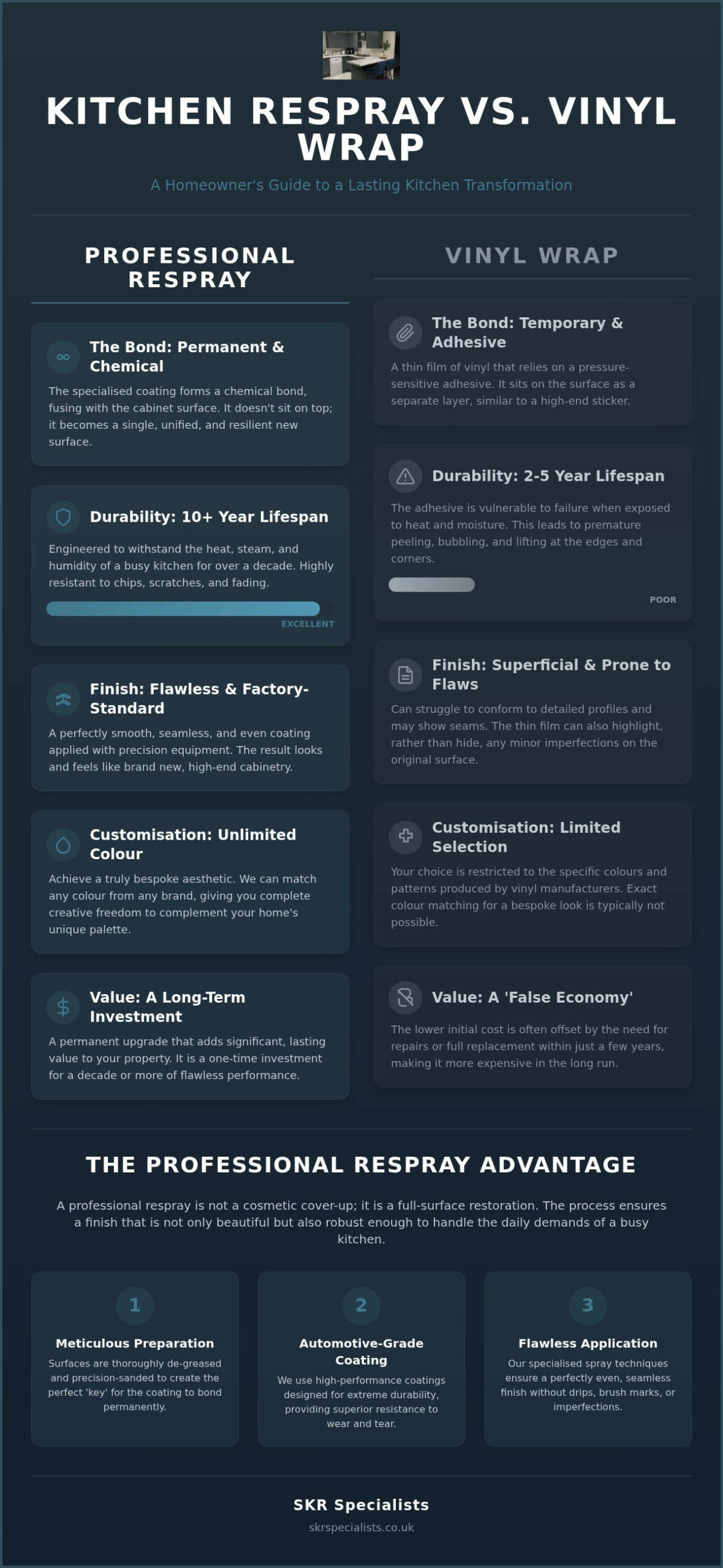
The core of the kitchen respray vs wrapping uk debate rests on how the new finish actually attaches to your cabinets. A vinyl wrap is essentially a skin that relies on pressure-sensitive adhesives. It sits on top of the surface as a separate layer. In contrast, a professional respray involves a chemical reaction. The coating isn’t just sitting on the door; it’s bonding with the substrate to become a single, unified surface.
Preparation is the non-negotiable phase of any high-end restoration. Whilst a wrapper might simply wipe a door down before application, our process requires meticulous de-greasing and precision sanding. This creates a “key” for the paint to bite into. Without this mechanical and chemical preparation, a finish cannot achieve the 10-year lifespan that discerning homeowners expect. We treat the surface as a canvas that must be perfectly primed before any colour is applied.
The Science of Adhesion in Kitchen Environments
We use specialist coatings that etch into the surface for a permanent grip. These are often the same high-performance materials used in the automotive industry, where finishes must survive extreme weather and heat. Vinyl adhesives are notoriously vulnerable to temperature fluctuations. In a typical British kitchen, the steam from a kettle or the heat from an oven can cause the adhesive to soften. This leads to the dreaded “edge-peel” that ruins the aesthetic.
A professional respray eliminates this risk. By using cross-linking chemical bonds, the finish remains stable regardless of the humidity or temperature in the room. This level of durability is why many property owners choose a professional kitchen unit respray over temporary alternatives. It’s a permanent upgrade rather than a cosmetic cover-up.
Application Methods: On-site vs Workshop
Achieving a true factory finish requires a controlled environment. We typically remove doors and drawer fronts to treat them in a dedicated spray booth. This prevents the “orange peel” texture often found in low-quality wraps or DIY projects, where dust and air bubbles get trapped under the film. When evaluating kitchen respray vs wrapping uk, the difference in application method is what defines the final quality.
The secret to this glass-smooth result is atomisation. Atomisation is the process of breaking down liquid coating into microscopic droplets using high-pressure equipment to ensure an even, consistent spread across the surface. This technique produces a finish that is indistinguishable from a brand-new kitchen. On-site wrapping, whilst faster, often struggles with imperfections caused by household dust and static, which are impossible to fully eliminate in a domestic setting.
Durability and Heat Resistance: Which Withstands a Busy British Kitchen?
A busy British kitchen is a high-stress environment for any surface. Between the humid clouds from a boiling kettle and the intense heat escaping an open dishwasher, your cabinet finishes face constant thermal expansion. When evaluating a kitchen respray vs wrapping uk homeowners often overlook how these daily stressors affect the longevity of the finish. Whilst a vinyl wrap relies on a surface-level adhesive, a professional respray becomes an integral part of the door itself. This fundamental difference determines whether your kitchen looks pristine for a decade or begins to fail within months.
UV light is another silent enemy of the modern kitchen. Over time, the plastics used in vinyl wraps can become brittle or discoloured when exposed to direct sunlight. We use high-performance, UV-stable pigments in our coatings that resist fading. This is particularly vital for those seeking a crisp, white finish. The repairability of these surfaces also differs vastly. If you scratch a resprayed door, it can often be touched up or local-sprayed to match perfectly. If you tear a vinyl wrap, the entire door usually needs to be stripped and re-wrapped, as patches are always visible.
The “Peeling” Problem: A Wrap’s Greatest Weakness
The most common failure point for vinyl wraps is around the oven and hob. Intense heat causes the vinyl to shrink and pull away from the edges of the door. This delamination is often irreversible because the adhesive dries out amongst older wraps, leaving the substrate exposed to moisture. It’s worth noting that even many high-street retailers sell new kitchens with “foil-wrapped” doors that suffer from these exact same issues over time. A resprayed surface behaves like a single solid layer. Because it’s chemically bonded to the material, there’s no separate film to shrink or peel, regardless of how much steam your kettle produces.
Longevity Expectations for 2026
Choosing the right method is about understanding the life cycle of your investment. A professional kitchen respray is a long-term restoration, with a typical lifespan of 10 to 15 years when maintained correctly. In contrast, budget or DIY kitchen wraps often begin to show signs of wear, bubbling, or edge-lifting within 2 to 5 years. For those planning a white or light-coloured renovation, we utilise non-yellowing, specialist coatings. These advanced formulas prevent the finish from taking on a “nicotine-stained” hue over time, which is a common problem with lower-quality paints and plastics. Investing in a professional spray-applied finish ensures your kitchen remains a centrepiece of the home for years to come.
Cost and ROI: Calculating the Real Value of Your Kitchen Transformation
When property owners weigh up kitchen respray vs wrapping uk, the initial quote is often the deciding factor. Vinyl wrapping usually enters the market at a lower entry point, making it attractive for a quick cosmetic lift. However, this often proves to be a “false economy” for those staying in their homes. If a wrap needs replacing every few years due to peeling or discolouration, the cumulative cost quickly overtakes that of a single, high-quality respray. We focus on providing a permanent solution that avoids the cycle of repeated repairs.
Speed is another critical component of return on investment. A full kitchen replacement often leaves your home in a state of chaos for two to four weeks. In contrast, our professional restoration process typically takes between two and five days. You aren’t just saving money; you’re saving weeks of disruption and the additional costs of eating out whilst your kitchen is out of action. A respray is often 70-80% cheaper than a full replacement, yet it delivers an aesthetic result that is indistinguishable from brand-new cabinetry.
Investment Breakdown: Spraying vs Wrapping
The price difference between these two methods reflects the level of craftsmanship involved. Wrapping is a labour-light process that uses mass-produced vinyl films and pressure-sensitive adhesives. Professional respraying requires a significantly higher level of skill, involving automotive-grade precision and industrial lacquers. When you evaluate the kitchen respray cost, you’re paying for the technical expertise of an expert craftsman and the durability of specialised coatings that a sticker simply cannot match.
The Value of a Factory Finish
Real estate experts often note that a high-quality kitchen is the primary driver of property value. A sprayed finish provides a tactile, premium feel that resonates with prospective buyers. They can see and feel the difference between a real paint finish and a plastic film. Prospective homebuyers generally prefer a sprayed finish because it suggests a level of permanent quality and care. A vinyl wrap, regardless of its initial appearance, can sometimes signal a “quick fix” to savvy buyers, potentially impacting their perception of the home’s overall maintenance standards.
If you’re ready to see how we can transform your space with a factory-standard finish that adds genuine value to your property, you can get a quote for your kitchen respray today. We provide the expertise needed to ensure your investment stands the test of time.
Achieving a Factory Finish: Why Professional Respraying Outperforms Wrapping
Choosing between a kitchen respray vs wrapping uk ultimately comes down to the standard of finish you expect to see every morning. Many large high-street retailers claim that a true factory-quality aesthetic is only possible by purchasing brand-new cabinetry. We challenge this notion by using the exact same industrial-grade coatings and high-pressure application techniques used in original manufacturing. A professional respray doesn’t just mimic a new kitchen; it restores your existing units to a standard that often exceeds the original finish.
One of the most significant technical hurdles for vinyl wrapping is the presence of intricate mouldings or deep grooves, such as those found on Shaker-style doors. Vinyl is a flat, two-dimensional material that must be heated and stretched to fit three-dimensional shapes. This creates inherent tension at the edges and in the corners, which is why wrapped doors often fail in these specific areas. Our spraying process allows the coating to flow seamlessly into every detail, providing a uniform, protective layer that a physical film simply cannot achieve. This creates a smooth, cohesive look across the entire kitchen unit.
Our founders’ background in high-precision automotive paint finishing ensures a level of detail that general trades cannot replicate. We apply the same discipline required for luxury vehicle restoration to your home. This means every surface is perfectly levelled, every edge is crisp, and the final result is free from the “orange peel” texture or trapped dust particles often seen in less specialised work. We don’t just change the colour; we renew the surface’s architectural integrity.
Unlimited Colour and Sheen Choice
The aesthetic freedom provided by respraying is far superior to the limited catalogues of vinyl manufacturers. Whilst wrapping companies are restricted to stock colours, we can match any shade from premium brands like Farrow & Ball or the universal RAL colour chart. This allows you to create a truly bespoke space, perhaps by opting for a sophisticated two-tone kitchen with a contrasting island. You also have total control over the light-reflectance of your cabinets, with the ability to choose between a modern matt, a soft satin, or a high-impact gloss. If you are wondering is kitchen cabinet spraying durable enough for such custom finishes, the answer lies in the industrial cross-linking lacquers we use, which are designed to withstand years of heavy use.
The Verdict for 2026
The evidence for 2026 is clear. For homeowners seeking a long-term, high-end transformation that adds tangible property value, a professional respray is the superior choice. It offers a permanent chemical bond and a flawless texture that wrapping cannot match. Vinyl wrapping may remain an acceptable choice for a very short-term rental refresh or a low-budget DIY project, but it lacks the resilience required for a primary family home. If you want a kitchen that looks and feels brand new for the next decade, the investment in professional craftsmanship is essential. To begin your transformation, simply send us a few photos of your kitchen via our digital portal for a fast, accurate quote.
Secure a Lasting Transformation for Your Home
Deciding between a kitchen respray vs wrapping uk comes down to the longevity you expect from your investment. Whilst a vinyl wrap offers a quick cosmetic lift, it remains a temporary surface layer prone to heat damage and edge-peeling. A professional respray provides a permanent chemical bond and a flawless, factory-standard finish that adds genuine value to your property. By choosing restoration over replacement, you achieve a bespoke look without the waste or disruption of a full renovation.
Our expert craftsmen bring automotive-grade precision and durability to every project, ensuring your cabinets can withstand the rigours of daily use for over a decade. We offer full national UK coverage for both residential and commercial properties, backed by years of specialist experience in high-end surface renewal. Transform your kitchen with a factory-grade respray from SKR Specialists and rediscover the heart of your home. Your kitchen’s next chapter starts with a simple photo for a quote.
Frequently Asked Questions
Is it better to spray or wrap kitchen cupboards?
A professional respray is the superior choice for homeowners seeking a permanent, high-quality restoration. Whilst wrapping provides a quick aesthetic change, it lacks the chemical bond and durability of a spray-applied coating. When weighing up a kitchen respray vs wrapping uk property owners should consider that a respray behaves as a single solid layer. This prevents the edges from lifting, a common failure point for vinyl films in busy homes.
How long does a kitchen respray last compared to a wrap?
A professionally applied kitchen respray typically lasts between 10 and 15 years with standard care. In contrast, vinyl wraps have a much shorter life cycle. Budget wraps often begin to show wear or bubbling within 2 to 5 years. Even premium architectural films rarely match the decade-plus durability of an industrial-grade lacquer. This makes respraying a more sustainable, long-term investment for those who want a kitchen that stays looking new.
Can you see the difference between a sprayed and wrapped kitchen?
Yes, the visual and tactile differences are distinct. A respray delivers a seamless, factory-standard finish that flows perfectly into mouldings and corners. Vinyl wraps are physical films that must be stretched over shapes, often leaving visible seams or “tenting” in deep grooves. A sprayed surface feels like real cabinetry, whereas a wrap retains a plastic, “sticker-like” texture that savvy homebuyers can easily identify as a temporary cosmetic fix.
Does kitchen wrapping peel off over time?
Kitchen wrapping is highly susceptible to peeling, particularly around high-heat areas like ovens and hobs. The adhesive backing can dry out or soften when exposed to steam from kettles and dishwashers. This process, known as delamination, causes the edges to curl and pull away from the unit. Unlike a wrap, a respray creates a permanent chemical bond with the substrate, eliminating the risk of the finish ever lifting or peeling away.
Can you respray a kitchen that has already been wrapped?
You can certainly respray a kitchen that was previously wrapped, provided the vinyl is completely removed first. We strip the old film to reveal the original substrate, which we then meticulously clean and sand. This preparation is vital to ensure the new coating achieves a factory-standard bond. Attempting to spray directly over vinyl is never recommended, as the paint cannot chemically etch into the plastic film to create a durable finish.
What is the cost difference between kitchen respray and wrapping in the UK?
Initially, vinyl wrapping is often the cheaper option, but it frequently represents a false economy. Professional respraying sits in the mid-range of kitchen renovation costs, providing a result that is 70-80% cheaper than a full replacement. When you factor in the 10-year lifespan of a respray versus the likely need to re-wrap within a few years, the long-term value of a kitchen respray vs wrapping uk clearly favours the sprayed finish.
Is a kitchen respray heat resistant?
Yes, professional resprays are exceptionally heat resistant. We use industrial-grade cross-linking lacquers that remain stable even in the high-temperature zones around ovens and stovetops. These coatings don’t soften or shrink like the adhesives and plastics used in vinyl wrapping. This thermal stability ensures that your kitchen maintains its crisp, factory-fresh appearance without the warping or bubbling often associated with heat-sensitive films in a busy British home environment.
How do I clean a resprayed kitchen vs a wrapped one?
Both surfaces are easy to maintain, but a resprayed finish offers superior chemical resistance. You can clean a sprayed kitchen with a soft microfibre cloth and mild soapy water. Vinyl wraps are more delicate; aggressive scrubbing or certain household chemicals can damage the film or weaken the adhesive at the edges. Our resprayed surfaces are much more resilient to the standard spills and cleaning routines of a busy modern household.