
Garage Door Paint Peeling Fix: The Professional Guide to Restoration (2026)
That unsightly flake on your driveway isn’t just a cosmetic blemish; it’s the final symptom of a total mechanical failure between the paint and the substrate. It’s incredibly frustrating to watch your home’s kerb appeal decline, especially if you’ve already spent a bank holiday on a DIY repair that didn’t even last the season. Finding a permanent garage door paint peeling fix feels like a moving target whilst you’re battling confusion over which primers to trust on metal or UPVC surfaces.
We understand the desire for a home that looks pristine without the unnecessary expense of a full replacement. This guide reveals the professional restoration secrets required to achieve a durable, factory-standard finish that actually lasts. You’ll discover the root causes of adhesion failure and the exact technical steps used by expert craftsmen to ensure your finish stays bonded. From stripping old layers to selecting specialised coatings, we’ll show you how to transform a weathered surface into a high-end architectural feature that rivals a brand-new installation.
Key Takeaways
- Identify the environmental triggers, such as UV degradation and moisture ingress, that compromise the bond on metal and UPVC surfaces.
- Understand why a professional respray delivers a decade of durability whilst DIY brush-applied methods often fail within two years.
- Discover the precise technical stages of a permanent garage door paint peeling fix, from chemical decontamination to factory-standard coating.
- Learn the essential maintenance habits that protect your investment by neutralising corrosive salts and preventing future micro-cracks.
- Realise the transformative potential of specialised restoration as a savvy, high-quality alternative to the expense of a total door replacement.
Understanding Why Garage Door Paint Peels (The Root Causes)
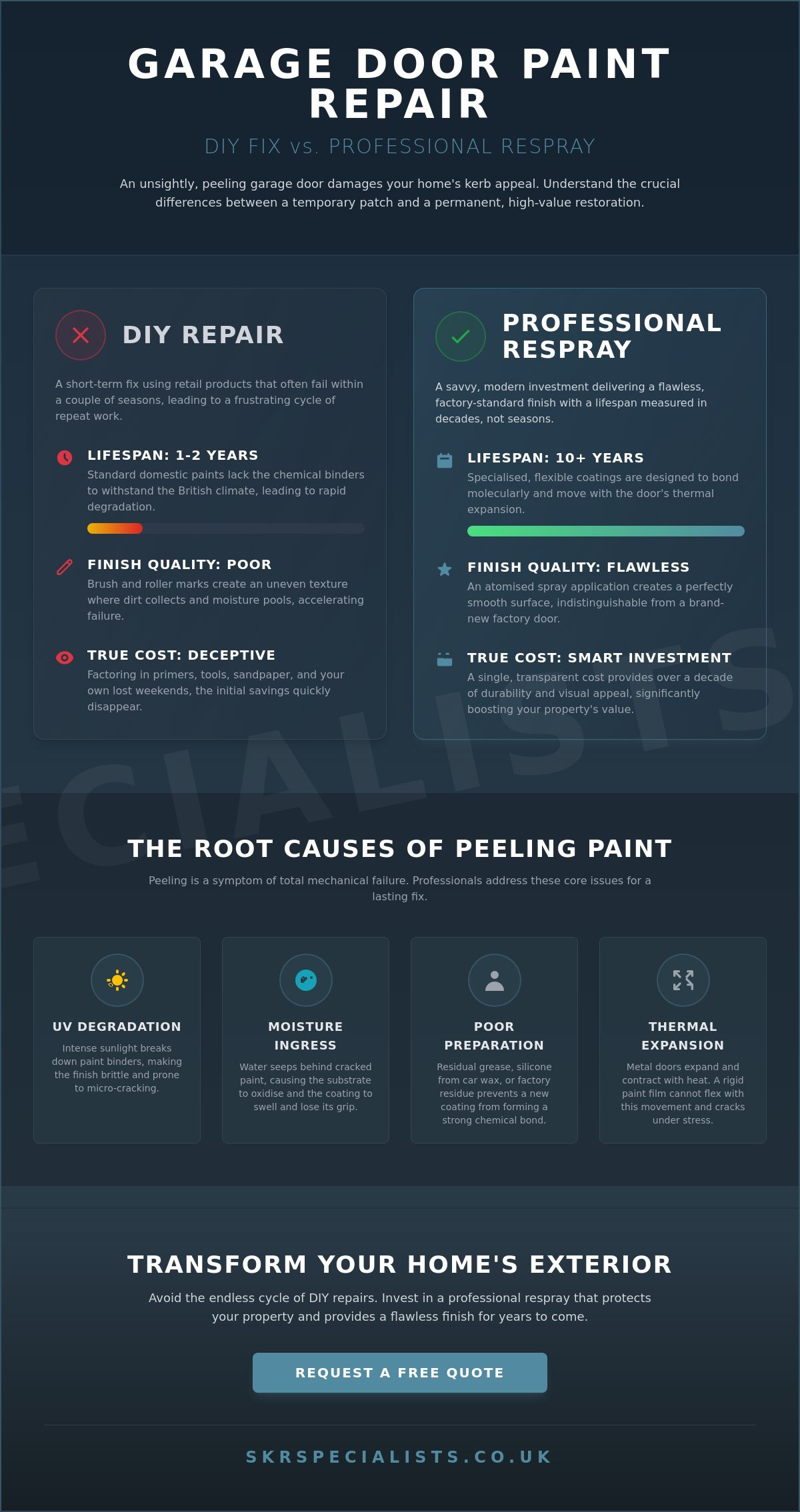
Peeling paint is rarely a random occurrence. It is the visible result of a total mechanical failure between the coating and the substrate underneath. When homeowners search for a permanent garage door paint peeling fix, they are often battling a combination of environmental stressors that have systematically compromised the paint’s bond. We see this most frequently on south-facing doors where UV degradation becomes the primary catalyst. Intense sunlight breaks down the chemical binders in standard domestic paints, making the finish brittle and prone to hairline fractures. Once these cracks appear, moisture ingress takes over. Rainwater seeps behind the paint film, causing the substrate to oxidise or the paint to swell and lose its grip.
The challenge is amplified on non-porous surfaces like galvanised steel or UPVC. Unlike timber, which allows paint to “root” into the grain, metal and plastic require a sophisticated chemical bond. Without the correct molecular anchoring, the paint simply sits on the surface like a skin. Professionals utilise Paint adhesion testing to understand how well a coating is performing, and the results often show that domestic-grade products lack the tenacity to survive the British climate. Humidity and salt air, particularly in coastal regions, act as corrosive agents that accelerate this flaking process by attacking the edges of any micro-cracks.
Many properties also suffer from the “layering trap.” This occurs when previous DIY attempts have added layers of incompatible paint over an already failing base. These heavy, unstable coats create a thick “crust” that is too rigid to cope with the door’s natural movement. Eventually, the weight of the new layers pulls the original, weakened primer away from the door entirely, leading to large-scale delamination that sanding alone cannot resolve.
Thermal Expansion and Substrate Movement
Garage doors are dynamic structures. Metal doors expand and contract significantly as they absorb solar heat throughout the day. If the coating is too rigid, it cannot stretch with the substrate, leading to immediate cracking. We utilise specialised, flexible coatings designed to move in harmony with the door. Thermal shock is a leading cause of paint cracking on south-facing doors, occurring when a hot surface is suddenly cooled by a summer rain shower, causing the metal to contract faster than the paint film can react.
Poor Initial Preparation: The Silent Killer
The longevity of any finish is decided before the first drop of paint is applied. Residual grease, silicone wax from car cleaning, or even the original factory “bloom” can prevent a new coating from bonding. On steel doors, flash rusting is a major concern; microscopic oxidation can form within minutes of cleaning if the surface isn’t treated correctly. Simply sanding the edges of a peel is never a permanent fix because it leaves the underlying contamination in place, ensuring the next failure is only a season away.
DIY Repair vs. Professional Respraying: Which Fix is Best?
Choosing between a weekend DIY project and a professional respray often comes down to a misunderstanding of long-term value. While a tin of retail paint seems like a cost-effective garage door paint peeling fix, the reality is often a cycle of repetitive failure. A typical DIY brush-applied job generally lasts between one and two years before the British weather begins to exploit vulnerabilities in the finish. In contrast, a professional respray utilising industrial-grade coatings provides a lifespan exceeding ten years. The aesthetic gap is equally vast. Brushes and rollers leave behind ‘valleys’ and textures where water pools and grit accumulates, whereas a specialist finish is indistinguishable from a factory-new door.
The hidden costs of DIY are significant. Once you account for premium primers, specialised degreasers, high-quality brushes, and the inevitable mountain of sandpaper, the price gap narrows. When you factor in your own time, usually a full weekend of back-breaking preparation and painting, the efficiency of a professional becomes clear. A specialist team can often complete the entire transformation in a single day, leaving you with a flawless result and no messy equipment to clean. If you are looking for a permanent solution rather than a temporary patch, a Garage Door Respray is the smarter, more modern investment. Before committing to any approach, it is also worth understanding the full garage door colour change cost compared to a total replacement, as the financial case for professional respraying is often far stronger than homeowners expect.
The Limitations of Retail Paint Products
High-street retail paints are designed for ease of application by amateurs. This usually means they lack the aggressive adhesion promoters found in specialist industrial coatings. These off-the-shelf products rely on simple air-drying, which leaves the film soft and susceptible to ‘blocking’—a frustrating issue where the door sticks to the frame or rubber seals. Professionals use fast-curing, cross-linking resins that create a chemically hardened surface. Research into Understanding Why Paint Peels shows that without these specific molecular bonds, coatings on non-porous substrates like metal are destined to fail under thermal stress.
Why Equipment Matters: HVLP Spraying vs. Brushes
The tools define the final result. Brushes cannot reach deep into the intricate recesses of a panelled door without leaving drips or uneven build-up. We utilise High Volume Low Pressure (HVLP) spraying systems to atomise the paint into a fine mist, ensuring a perfectly even coat across every millimetre of the surface. This technology eliminates the dreaded ‘orange peel’ effect, the bumpy, uneven texture common in amateur attempts. For a deeper look at the technology and precision required for these results, see our Professional Garage Door Painting guide.
The Professional Step-by-Step Garage Door Paint Peeling Fix
Achieving a permanent garage door paint peeling fix requires a transition from general maintenance to specialised craftsmanship. We don’t just paint over the cracks; we restore the integrity of the substrate through a rigorous five-stage process. This methodical approach ensures that the bond between the door and its new coating is chemically and mechanically superior to any standard DIY application. The transformation begins by stripping the surface back to a stable foundation before rebuilding it with automotive-grade precision. For homeowners weighing up their options, understanding the garage door spray painting cost against the long-term value of a professional restoration is an essential first step.
- Stage 1: Complete removal of all unstable, flaking, and loose paint layers to prevent future delamination.
- Stage 2: Intensive degreasing and chemical cleaning to eliminate atmospheric pollutants, waxes, and oils.
- Stage 3: Mechanical abrasion of the entire surface to create a high-performance ‘key’ for the new coating.
- Stage 4: Application of a substrate-specific etch primer or high-tenacity adhesion promoter.
- Stage 5: Multi-coat spray application of a bespoke, weather-resistant topcoat for a factory-standard finish.
Stripping and Surface Neutralisation
We use mechanical stripping to address widespread delamination, whilst chemical peelers are reserved for stubborn, original factory coatings that refuse to budge. Once the loose material is gone, surface neutralisation is vital. This step ensures that no residual chemical cleaners remain to interfere with the new paint. We use a feathering technique during the sanding process to smooth the edges of any remaining old paint. This prevents visible ‘steps’ in the final finish and ensures the new coating flows seamlessly across the entire door.
Priming for Permanent Adhesion
Substrate identification is the most critical part of the preparation phase. A primer designed for aluminium will not perform effectively on galvanised steel or UPVC. A ‘one-size-fits-all’ primer is the most common reason for future peeling because it fails to address the specific chemical needs of the material. We utilise specialised metal garage door painting techniques to ensure the etch primer bites into the surface. This creates a molecular anchor that resists the thermal expansion cycles discussed earlier, guaranteeing that your new finish remains bonded for years to come.
Finally, the spray application involves multiple thin, even coats rather than one heavy layer. This builds a resilient shield that is both flexible and incredibly tough. By using High Volume Low Pressure technology, we ensure the paint reaches every recess and return of the door’s profile, leaving a smooth, uniform surface that looks better than the day it was first installed.
Essential Maintenance: Preventing Future Peeling
Preserving the integrity of your finish is just as important as the initial restoration. Once you have implemented a professional garage door paint peeling fix, a simple maintenance schedule will protect that bond from the harsh British climate. Environmental contaminants are the silent enemies of any exterior coating. Corrosive road salts during winter and acidic bird droppings throughout the year can compromise the topcoat if they aren’t removed. We recommend a gentle wash every few months to neutralise these substances before they have a chance to settle into the finish.
Water management plays a critical role in preventing future delamination. If garden sprinklers regularly soak the door or if standing water pools at the bottom edge, the coating is under constant moisture stress. This environment encourages capillary action, where water is drawn behind the paint film. You should also resist the urge to use a pressure washer on its highest setting. The intense force can catch the microscopic edges of the paint, acting like a hydraulic wedge that can lift even the most professional coatings.
Cleaning and Environmental Protection
Always choose mild, pH-neutral detergents for your cleaning routine. Harsh household chemicals or abrasive sponges can scour the surface, removing the vital UV inhibitors that prevent fading. For properties located near the coast, we advise cleaning the door at least once a month to prevent salt crusting. A simple application of high-quality automotive wax once a year can extend the life of the respray significantly. This keeps the surface hydrophobic, ensuring that rainwater beads and rolls away rather than sitting on the substrate.
Spot Repairs vs. Full Refurbishment
Conducting an annual inspection allows you to identify micro-cracks before they turn into full peels. A single stone chip might seem minor, but it provides a gateway for moisture to reach the metal or UPVC underneath. You must address these small points of entry immediately to maintain the seal. If the door is already showing signs of widespread flaking, ‘patching’ the area is rarely a permanent solution. This usually suggests that the underlying bond of the previous coating has failed entirely. When you notice systemic issues or an aesthetic mismatch from sun-fading, it is often more cost-effective to book a professional Garage Door Respray rather than attempting temporary fixes.
Transform Your Home with SKR Specialists
SKR Specialists represents a shift in the home improvement market. We don’t just treat the symptoms; we solve the underlying engineering failure with a permanent garage door paint peeling fix. Our background in high-precision technical trades means we approach your property with the same discipline required for industrial or automotive finishes. This isn’t general labour; it’s a specialised craft that transforms weathered, flaking surfaces into architectural assets. By choosing to respray rather than replace, you are opting for a modern, value-driven solution that bypasses the disruption and waste of structural changes.
Our national team of expert craftsmen operates with a no-nonsense efficiency that respects your time and property. We understand that a home is an investment, and our role is to protect and enhance that investment through superior technical application. Whether your door is galvanised steel, aluminium, or UPVC, we apply the same rigorous standards to ensure the final result is indistinguishable from a factory-standard installation. This commitment to excellence ensures your property stands out for the right reasons, backed by a finish designed to endure the British climate.
The SKR Factory-Quality Finish
We use the metaphor of renewal to describe our work because the results are truly transformative. Tired, peeling surfaces that most homeowners assume are destined for the scrap heap are given a second life through our meticulous process. To maintain our momentum and efficiency, we utilise a modern, digital-first approach to quoting. By sending us a photo of your door, you receive immediate feedback and pricing, removing the need for traditional, time-consuming site visits. This streamlined process reflects our commitment to punctuality and professional discipline.
Beyond the Garage: A Coordinated Look
The aesthetic value of a professional respray is most powerful when viewed as part of a wider property transformation. Many of our clients choose to coordinate their garage door with a kitchen respray or a full update of their UPVC windows and doors. This creates a cohesive, high-end look that drastically improves your home’s kerb appeal without the staggering costs of total replacement. A unified colour palette across your exterior surfaces signals a level of care and quality that standard domestic maintenance cannot achieve. Renew your garage door today with SKR Specialists and join the property owners who have chosen the smarter, more durable path to home restoration.
Restore the Architectural Value of Your Home
A failing finish doesn’t have to mean a costly replacement. You now understand that a permanent garage door paint peeling fix relies on more than just a fresh coat of paint; it requires a systematic restoration of the chemical bond between the substrate and the coating. By prioritising specialised preparation and substrate-specific primers, you can avoid the repetitive cycle of DIY failure and achieve a result that lasts a decade. Our expert craftsmen bring automotive-grade precision to your driveway, ensuring every panel receives a flawless, factory-grade HVLP spray finish.
We provide national UK coverage, delivering high-performance transformations that withstand the most challenging weather conditions. Our specialist coatings offer 10-year durability, giving you total confidence in the longevity of your home’s kerb appeal. Don’t settle for temporary patches when a high-quality, value-driven alternative is just a photo away. We are ready to help you rediscover the pride in your property’s appearance with a seamless, professional service.
Get a free, no-obligation quote for your garage door respray and begin your home’s transformation today.
Frequently Asked Questions
Can I just paint over peeling paint on my garage door?
You cannot simply paint over peeling layers if you want a lasting result. The existing flakes are a clear sign of bond failure; applying a new coat will merely add weight, pulling more of the old paint away from the substrate. A permanent garage door paint peeling fix requires the total removal of all loose material to ensure the new coating anchors directly to the door’s surface.
What is the best paint to use for a garage door that is already flaking?
The most effective products are industrial-grade, cross-linking resins rather than standard retail emulsions. These specialised coatings are engineered with aggressive adhesion promoters that bite into non-porous surfaces like steel or UPVC. Unlike air-drying DIY paints, these professional formulas create a chemically hardened shield that remains flexible enough to cope with the door’s natural movement.
How much does it cost to professionally fix a peeling garage door in the UK?
Professional restoration costs depend on the door’s dimensions, the material, and the extent of the existing damage. Stripping multiple layers of old DIY paint requires more intensive labour than a standard respray of a factory finish. For a detailed breakdown of what influences pricing in 2026, our garage door spray painting cost guide provides a comprehensive analysis to help you budget with confidence. We recommend providing digital photos of your door to receive an accurate, no-obligation quote tailored to your specific restoration requirements.
Why does my metal garage door keep peeling even after I’ve repainted it?
Metal doors often continue to peel because underlying “flash rust” or surface contamination wasn’t addressed before the new coat was applied. Thermal expansion also plays a massive role; as the metal expands in the sun, rigid retail paints crack and lose their grip. Without a professional-grade etch primer, the cycle of peeling will persist regardless of how many coats you add.
Is it better to sand or strip a peeling garage door?
It is usually necessary to perform both to achieve a factory-standard finish. Stripping is essential for removing unstable or thick layers that sanding alone cannot flatten. Once the surface is stripped back to a stable foundation, mechanical abrasion is required to create a microscopic “key” that allows the new primer to bond permanently to the door.
How long will a professional garage door respray last compared to DIY?
A professional respray typically provides over a decade of durability, whereas a DIY brush job often fails within two years. The difference lies in the application technology and the chemical composition of the coatings. We use HVLP spray systems to ensure an even, thin film that resists the cracking and “orange peel” textures common in amateur attempts.
Can you fix peeling paint on a UPVC garage door?
Yes, we can restore UPVC garage doors using specialised adhesion promoters designed specifically for plastic substrates. UPVC requires a coating with high flexibility to manage the significant thermal expansion these doors undergo in direct sunlight. Our process ensures the new finish becomes an integral part of the door’s surface rather than just a layer sitting on top.
Will the new paint peel if my garage door gets direct sunlight all day?
Professional coatings are specifically formulated with UV inhibitors to prevent degradation from direct sunlight. Whilst standard paints become brittle and flake under intense heat, our resins are designed to manage thermal shock and constant UV exposure. This ensures your garage door paint peeling fix remains vibrant and bonded even on the most exposed south-facing properties.