
UPVC Door Restoration: The Ultimate How-To Guide for 2026
Spending upwards of £1,500 on a new front door just because the colour has faded is a tradition that belongs in the past. It’s a common frustration for many UK homeowners. You look at your entrance and see chalky surfaces, yellowing frames, or a dated style that simply doesn’t match your home’s potential. You want that crisp, high-end aesthetic, but the thought of a messy and expensive structural replacement often feels like the only option.
There’s a more sophisticated, value-driven way to reclaim your property’s character. By opting for a professional upvc door restoration, you can achieve a durable, factory-quality finish that looks indistinguishable from a new installation. Using advanced chemical de-greasing and molecular bonding techniques, this process creates a resilient surface designed to withstand the elements for 10 years or more. This guide covers everything from technical resurfacing requirements to the boldest colour trends of 2026, including the shift towards Deep Navy and Charcoal Black, ensuring your home makes a stunning first impression without the unnecessary cost of new joinery.
Key Takeaways
- Discover why restoring your existing entrance is a superior, cost-effective alternative to expensive structural replacements.
- Understand the technical science behind “chalking” and how specialized coatings prevent UV degradation from returning.
- Learn the critical steps of a professional upvc door restoration, including chemical decontamination and surface keying for maximum durability.
- Compare the limitations of DIY kits against factory-grade spraying to ensure your door remains free from brush marks and peeling.
- Explore how high-precision technical trades apply automotive-grade technology to deliver a flawless finish that lasts for a decade.
What is Professional uPVC Door Restoration and Is It Worth It?
Professional uPVC door restoration isn’t just a quick fix for a scratch. It’s a comprehensive technical resurfacing process that takes tired, sun-bleached Polyvinyl chloride (PVC) doors and returns them to a factory-fresh state. Most homeowners assume that once a door looks “tired” or “chalky,” its life is over. That’s a common misconception that leads to thousands of pounds in unnecessary spending. Restoration bridges the gap between a simple soapy wash, which can’t fix UV damage, and a full structural replacement, which is often overkill.
Replacing a door in the UK is an invasive, expensive ordeal. You aren’t just paying for the door itself. You’re paying for the survey, the removal, the new frame, and the inevitable re-plastering or decorating of the surrounding hallway. Choosing a professional upvc door restoration avoids this disruption entirely. We focus purely on the aesthetic and protective layers of the existing unit, using chemical bonding to ensure the new finish becomes part of the door itself. It’s a smarter, modern approach to property maintenance that prioritises high-end results over high-cost replacements.
The Financial and Aesthetic Benefits of Restoration
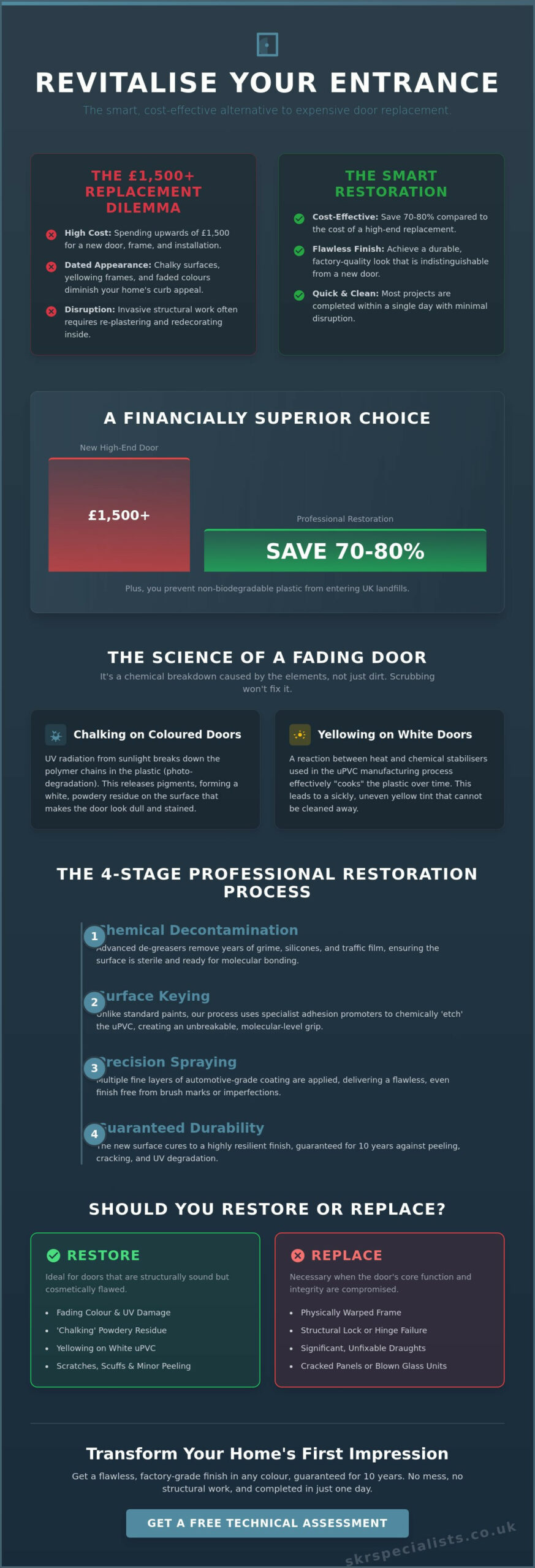
The numbers speak for themselves. Choosing professional upvc door restoration typically costs 70-80% less than purchasing a brand-new high-end door. It’s a savvy financial move that doesn’t sacrifice quality. Beyond the savings, the impact on curb appeal is immediate. A fresh, modern colour can completely transform a property’s exterior. Most of these projects are completed within a single day. You leave for work with a dated entrance and return to a home that looks like it’s had a full renovation. We also help you stay eco-conscious. By resurfacing rather than replacing, you’re keeping large amounts of non-biodegradable plastic out of UK landfills.
When to Restore vs. When to Replace
Knowing when to walk away from a door is vital. If your door is physically warped, the locking mechanism has failed structurally, or you can feel significant draughts that a new seal won’t fix, replacement might be the only route. However, most surface issues are perfect candidates for restoration. If your white door has turned a sickly yellow or your once-dark door has developed a white, powdery film known as “chalking,” these are purely cosmetic degradations. Chalking occurs when UV rays break down the top layer of the plastic. It looks terminal, but it’s actually a surface issue that we can solve with precision spraying, saving you the cost of a full installation.
The Science of Fading: Why Your uPVC Door Loses Its Lustre
Your door isn’t just dirty. It’s undergoing a slow chemical transformation. While uPVC is often marketed as “maintenance-free,” the reality of the British climate tells a different story. Direct sunlight is the primary culprit behind the visible decline of your entrance. Research into the Weathering of U-PVC highlights how UV radiation systematically breaks down the polymer chains within the plastic. This photo-degradation doesn’t just affect the surface; it alters the material’s integrity, leading to the common issues homeowners face after a few years of exposure.
The “chalking” effect is perhaps the most frustrating symptom for those with coloured doors, such as Anthracite Grey or Rosewood. As the polymer degrades, it releases pigments and fillers, forming a white, powdery residue on the surface. It’s a sign that the plastic is becoming porous. Once this happens, UK pollution and traffic film can penetrate deep into the substrate. This creates a dull, stained appearance that no amount of scrubbing can fix. For white doors, the “yellowing” mystery is usually down to a reaction between heat and the stabilisers used during manufacturing, effectively “cooking” the plastic from the inside out.
You can’t scrub away a chemical breakdown. Attempting to clean a chalking door often makes it look worse once it dries. This is where professional upvc door restoration becomes essential. We don’t just cover the damage; we treat the surface to stop the cycle of degradation. If you’ve noticed your entrance losing its vibrant finish, you can submit a photo of your door for a technical assessment by our specialists.
Molecular Bonding: The Key to a Permanent Fix
Standard domestic paints are designed for porous surfaces like wood or masonry. They simply cannot grip onto high-density plastic. Without a specialist adhesion promoter to “etch” the surface at a molecular level, any coating will eventually peel. Our process uses automotive-grade technology to create a permanent bond. We also carefully monitor the UK’s unpredictable humidity and temperature, as these variables dictate how the coating cures and settles into a factory-grade finish.
Thermal Expansion and Coating Flexibility
British seasons put immense physical stress on your home’s exterior. uPVC can move several millimetres in direct summer heat. This constant expansion and contraction is why cheap, rigid paints fail so quickly. They can’t move with the door, leading to unsightly cracks. A professional upvc door restoration utilises highly flexible coatings engineered to stretch and retract alongside the plastic. This ensures the finish remains flawless through freezing winters and scorching summers alike, providing a durable shield that lasts for a decade.
DIY Restoration Kits vs Professional Spraying: A Comparison
The temptation to grab a £20 “miracle” bottle from a local DIY shop is understandable. These wipe-on restoration liquids promise to reverse years of sun damage with a single cloth swipe. In reality, these products are often little more than silicone-based oils. They sit on the surface, temporarily filling the microscopic pits caused by UV degradation to create a fleeting shine. Once the British rain arrives, the effect vanishes, often leaving behind a greasy residue that attracts road film and grime. These kits don’t solve the problem; they merely mask it for a few months before the fading returns.
Hand-painting with a brush and a tin of “multi-surface” paint is another common pitfall. uPVC is a non-porous material, meaning standard paints cannot penetrate the surface to create a mechanical bond. This leads to visible brush marks, uneven textures, and the inevitable peeling within a few seasons. Many homeowners first ask can you paint uPVC before realising that the answer depends entirely on the specialist techniques and coatings used. A professional upvc door restoration avoids these aesthetic disasters by utilising atomisation technology. Instead of dragging a brush across the plastic, we use High Volume Low Pressure (HVLP) sprayers to apply a fine, even mist that settles into a perfectly flat, factory-grade finish.
The equipment gap is vast. A professional setup includes industrial-grade respirators and 2K (two-component) polyurethane coatings that aren’t available to the general public. These coatings involve a chemical hardener that triggers a permanent cure, something a standard tin of DIY paint simply cannot replicate. It’s the difference between a temporary “freshen up” and a structural aesthetic renewal that stands the test of time. If you’re wondering how long does upvc spray paint last when applied by a professional versus a DIY approach, the difference in lifespan is significant.
Durability and Lifespan Expectations
Longevity is where the investment truly pays off. DIY liquids typically fail within 6 to 12 months as the oils evaporate or wash away. Hand-painted attempts often start to flake or crack at the edges within 2 to 3 years because the paint hasn’t bonded at a molecular level. In contrast, a professional respray offers a lifespan of 10 years or more. These specialist coatings are UV-resistant and flexible, ensuring the colour remains as vibrant in year ten as it was on day one.
Value for Money and Property Impact
While the initial cost of a DIY kit is low, the cumulative cost of repeated applications and the risk of ruining a door’s surface make it a poor long-term choice. A professional finish adds genuine curb appeal and can even increase the perceived value of your home to potential buyers. For a detailed breakdown of what to expect regarding investment, you can check the upvc door respray cost uk for a comprehensive price guide. Choosing a high-end finish today prevents the need for a £1,500 replacement tomorrow.
The Professional uPVC Door Restoration Process: A Step-by-Step Guide
Achieving a factory finish on an aged door requires more than a steady hand. It’s a disciplined sequence of technical steps designed to ensure the new coating behaves like the original plastic. Unlike general trade painting, a professional upvc door restoration follows a strict industrial protocol. We don’t just spray over the old surface; we rebuild the aesthetic from the substrate up. This meticulous approach ensures that the final result isn’t just a change of colour, but a permanent renewal of the material itself.
- Step 1: Deep Decontamination. We remove every trace of silicone, wax, and UK road film. These contaminants are the primary cause of paint failure. We use industrial-strength de-greasers to strip the surface back to a raw, neutral state.
- Step 2: Surface Abrasion. This involves “keying” the plastic. By gently abrading the surface, we create a microscopic texture. This texture allows our specialist primers to anchor themselves at a molecular level.
- Step 3: Structural Repair. We don’t ignore physical damage. We use specialist fillers to mend chips, deep scratches, or old screw holes, ensuring the final surface is perfectly level and smooth.
- Step 4: Precision Masking. We protect everything that shouldn’t be coloured. This includes the glass units, handles, letterboxes, and the surrounding brickwork or render.
- Step 5: Specialist Coating. We apply multiple layers of UV-stable, automotive-grade paint. This creates a resilient, uniform shield that looks indistinguishable from a brand-new door.
Preparation: The Most Critical Stage
Skipping even a minor part of the de-greasing stage leads to immediate coating failure. Silicone, often found in glass cleaners or car waxes, is a “non-stick” substance that prevents paint from bonding. We use high-tack cloths to remove every speck of dust whilst spraying to maintain a sterile environment. We also take great care with rubber gaskets and weather seals. These are either masked or treated with specific techniques to ensure they remain soft and functional. This ensures your door maintains its draught protection long after the professional upvc door restoration is complete.
The Finishing Touches and Reassembly
The final reveal is a matter of precision timing. We remove the masking tape at a specific point in the curing process to ensure the lines between the new colour and your glass are crisp and sharp. Once the coating is touch-dry, we re-install your hardware. Many homeowners choose this moment to upgrade their handles or letterboxes for a total transformation. To see how this fits into your home improvement budget, you can learn more about the cost to spray paint a front door to plan your project effectively. If you’re ready to see what’s possible for your home, request a technical quote today and let our experts handle the transformation.
Achieving a Factory-Grade Finish with SKR Specialists
SKR Specialists don’t just paint doors. We apply a technical resurfacing protocol born from high-precision trades. By utilising automotive-grade technology, we ensure that every professional upvc door restoration we undertake meets a standard far beyond domestic decorating. This level of craftsmanship is what differentiates a specialist from a general tradesperson. We treat your property with the same meticulous detail required for high-end vehicle finishing. The result is a surface that is as durable as it is beautiful, providing an aesthetic renewal that standard paints simply cannot achieve.
Our commitment to efficiency means your home doesn’t become a building site for days on end. We’ve refined our process to be entirely mess-free, with most projects reaching completion in just a few hours. This rapid turnaround is made possible by our specialised equipment and industrial coatings, which cure much faster than standard retail products. You gain the peace of mind that comes with a UV-resistant finish that won’t fade or peel, outperforming any DIY kit or hand-painted attempt by a significant margin. It’s a savvy, long-term investment in your property’s future.
Why Choose Professional Restoration Over Replacement?
Replacing a door is a structural event. It often involves hacking away at plasterwork, damaging floor tiles, and leaving your hallway exposed to the elements whilst the new frame is fitted. By choosing restoration, you avoid this chaos entirely. You retain the thermal efficiency and structural integrity of your existing frame whilst completely updating the aesthetic to match 2026 trends. It’s the smarter choice for property owners who value both quality and convenience. For a deeper look at the transition from tired plastic to a modern masterpiece, see our professional upvc door spray painting guide.
Ready to Transform Your Home Entrance?
We’ve made the first step as simple as possible. You don’t need to wait for a surveyor to visit your home and take up your evening. Our digital-first approach allows us to provide an accurate, transparent quote based purely on photos of your door. We provide national coverage across the UK, servicing both residential and commercial properties with the same level of disciplined precision. If you’re ready to modernise your home and reclaim your property’s curb appeal, we invite you to take the next step. Upload your photos today for a professional assessment and discover how we can deliver a factory-fresh finish to your existing entrance.
Secure Your Property’s Visual Renewal
Choosing a professional upvc door restoration is a commitment to quality over convenience. You’ve seen how molecular bonding and automotive-grade paint technology outperform temporary DIY fixes; this provides a finish that stands up to the British elements for a decade. By opting for restoration, you bypass the unnecessary disruption and high costs of structural replacements whilst achieving a result that looks indistinguishable from a factory-new installation.
SKR Specialists bring a background in high-precision technical trades to every project, ensuring your home benefits from a level of detail that general trade practitioners simply can’t match. We provide a 10-year adhesion guarantee and nationwide UK service. This gives you total confidence in the longevity of your home’s new look. It’s time to stop settling for a faded entrance and start enjoying a modernised home that reflects your standards.
Get your free uPVC door restoration quote from SKR Specialists today. Our experts are ready to transform your property with efficiency and precision. We’ll show you that a premium finish doesn’t have to come with a premium price tag.
Frequently Asked Questions
Can all types of uPVC doors be restored?
Yes, almost any uPVC door can be restored as long as the frame is structurally sound. This includes standard front doors, back doors, French doors, and sliding patio units. We focus on the surface condition of the plastic. Even if the surface is heavily chalked or yellowed, our technical resurfacing process can return it to a factory-fresh appearance. If your door has deep physical gouges, we use specialist fillers to level the surface before the coating is applied.
How long does a professional uPVC door restoration actually last?
You can expect a professional finish to last for 10 years or more. Unlike DIY kits that sit on the surface, a professional upvc door restoration involves molecular bonding that makes the new colour part of the substrate. Our automotive-grade coatings are specifically engineered for external durability. They’re designed to withstand the unpredictable British weather without fading, cracking, or losing their lustre over time. For a detailed scientific breakdown of how long does upvc spray paint last under real-world conditions, our specialist guide covers the full lifespan expectations.
Will the paint on my uPVC door peel off in the summer sun?
No, the finish will not peel when applied correctly by a specialist. We use flexible, heat-reflective coatings that are designed to move with the plastic. Because uPVC expands and contracts several millimetres during the UK summer, standard rigid paints would eventually crack. Our specialist coatings maintain their integrity during these thermal shifts, ensuring the bond remains permanent regardless of the temperature.
Can you change the colour of a dark uPVC door to a lighter one?
Yes, we can transition any dark door to a much lighter shade without any “show-through” of the original colour. Our high-opacity coatings provide total coverage even when moving from a deep Rosewood or Anthracite Grey to a light Cream or White. We apply multiple precision layers to ensure a uniform, solid finish that looks exactly like a new door straight from the manufacturer.
Is it possible to restore composite doors using the same methods?
Yes, composite doors are ideal candidates for our restoration and respraying techniques. While the core materials differ from standard uPVC, the outer GRP (glass-reinforced plastic) skin reacts exceptionally well to our specialist adhesion promoters. The process is virtually identical, resulting in a high-end finish that can completely change the look of your home’s entrance whilst retaining the door’s original thermal properties.
How much does professional uPVC door restoration cost compared to a new door?
Restoration is a significantly more cost-effective choice, typically costing a small fraction of a full replacement. Most property owners find they save between 70% and 80% by choosing to restore rather than replace. You also avoid the hidden costs associated with new installations, such as hiring a surveyor or paying for re-plastering and decorating once the old frame has been ripped out.
Do I need to take the door off its hinges for the restoration process?
No, we complete the entire professional upvc door restoration whilst the door remains on its hinges. Our specialists use precision masking techniques to protect all hardware, glass, and gaskets. Working in situ ensures your home remains secure and weather-tight throughout the day. It also prevents any potential damage or alignment issues that can occur when removing and re-hanging heavy door leaves.
What is the best time of year to have my uPVC door restored in the UK?
We can perform restorations year-round in the UK, provided the conditions are dry and the temperature is above 5°C. Whilst many people prefer the spring and summer months, our fast-curing coatings allow us to achieve perfect results in autumn and winter too. We carefully monitor local humidity levels and wind speeds to ensure the environment is suitable for a flawless, dust-free finish every time.