
Can You Paint UPVC? Professional Insights for UK Homeowners in 2026
The ‘obvious’ choice of replacing yellowing window frames is often the most expensive mistake a homeowner can make. You have likely looked at your tired, sun-bleached exterior and wondered, can you paint upvc without it peeling off during the next British downpour? It is a valid concern. Nobody wants to ruin their property with a flaky, amateur finish, yet the prospect of spending thousands on total replacements feels like an unnecessary burden on your bank account when the frames themselves are structurally sound.
We understand that you want a modern, factory-fresh look without the disruption of a construction site. This guide provides the definitive answer to your renovation dilemmas. You will discover the science behind professional molecular bonding and how specialised spray-painting delivers a durable finish that survives the harshest weather. We will also outline the latest 2026 insights on achieving significant cost savings and why choosing a specialist finish is the smartest way to transform your home exterior whilst protecting your investment for the long term.
Key Takeaways
- Discover why the definitive answer to can you paint upvc is a resounding yes, provided you use specialised coatings that bond at a molecular level rather than just sitting on the surface.
- Learn how a professional respray can save you up to 80% compared to the price of new UPVC installations whilst delivering an identical factory-standard finish.
- Understand the technical superiority of spraying over hand-painting to avoid the ‘orange peel’ effect and ensure paint doesn’t clog window mechanisms or gaskets.
- Explore the professional multi-stage cleaning and chemical keying process that ensures your property’s new look survives the British weather for years to come.
- Identify the value of choosing specialist craftsmen with automotive-grade precision to achieve a seamless, durable aesthetic transformation for your home.
Addressing the Question: Can You Paint UPVC Successfully?
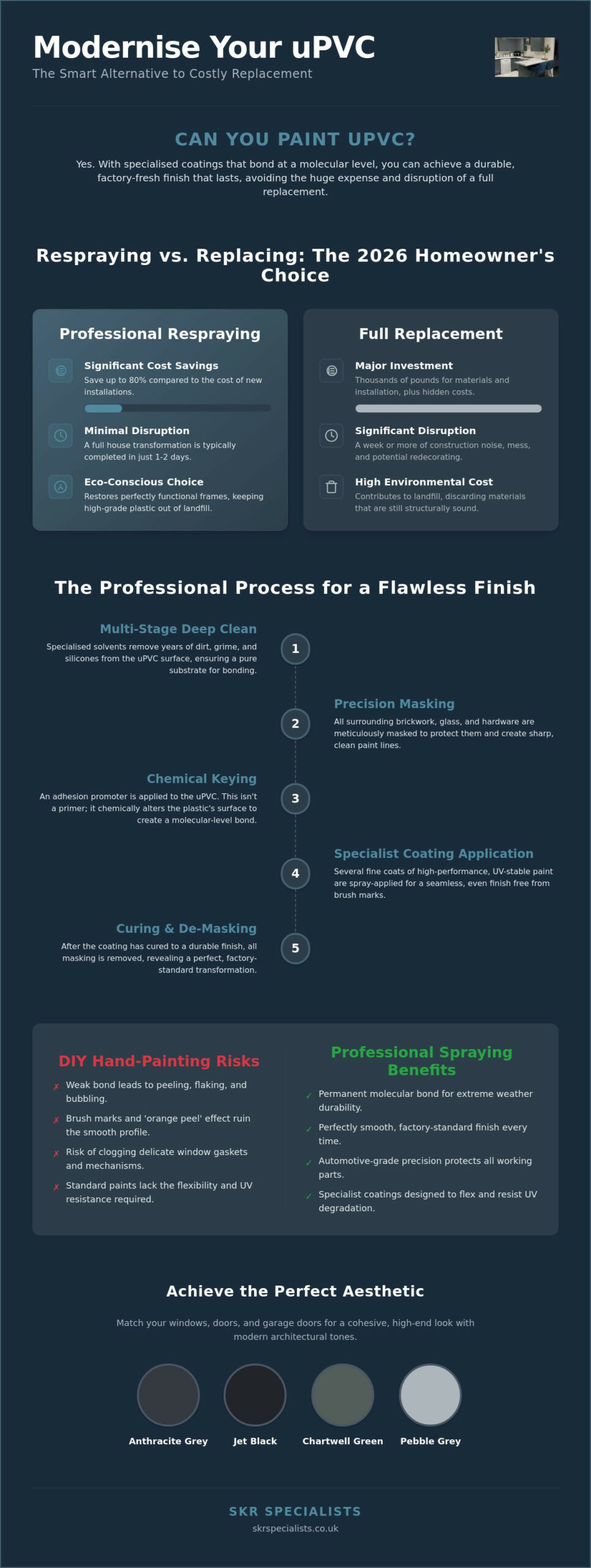
The short answer is yes. You certainly can paint UPVC, but the success of the project relies entirely on the bond created between the coating and the substrate. Standard exterior paints designed for wood or masonry simply cannot grip the non-porous, ‘low energy’ surface of plastic. Instead of soaking in, they sit on top. This leads to inevitable peeling and cracking within months. In 2026, we are seeing a massive shift across the UK. Homeowners are moving away from the dated look of standard white frames in favour of architectural tones like Anthracite Grey or Chartwell Green. This isn’t just about aesthetics; it’s about restoration. Choosing to respray rather than replace is the smartest choice for eco-conscious property owners who want to avoid sending perfectly functional frames to a landfill.
What Exactly is UPVC?
Polyvinyl chloride (UPVC) is a rigid, unplasticised form of plastic used extensively in UK housing for its durability and thermal properties. It is engineered to be weather-resistant and low-maintenance, which is exactly why it is so difficult to decorate. The smooth surface is designed to repel moisture and dirt, which means it also repels traditional paint. Over time, older frames often suffer from UV degradation. This leaves them looking ‘chalky’ or yellowed. While this looks like the end of the window’s life, it actually provides a slightly more porous surface that, when professionally prepared, allows for an incredible chemical bond.
The Difference Between ‘Can’ and ‘Should’
Just because you can buy a tin of ‘all-surface’ paint from a DIY shop doesn’t mean you should apply it to your windows. You have likely asked yourself, can you paint upvc without ruining the value of your home? The risks of using the wrong materials are high. A bad paint job will flake and bubble, often ruining the smooth profile of the frame and potentially clogging the delicate gaskets or opening mechanisms. There is a vast aesthetic gap between a brush-painted door and a professional respray. A specialist spray finish provides a seamless, factory-standard appearance that looks original to the house. When you consider that a full replacement for a semi-detached home can cost thousands, professional painting becomes a highly viable, high-end alternative that delivers the same visual impact for a fraction of the investment.
Why Homeowners are Choosing UPVC Respraying in 2026
The shift towards restoration in 2026 is driven by a desire for high-end aesthetics without the luxury price tag. Modern homeowners are no longer content with the ‘standard’ white plastic look that defined the previous decades. Instead, they are looking for ways to modernise their property’s exterior whilst being mindful of both their budget and the environment. If you have questioned can you paint upvc to achieve a bespoke look, the surge in professional respraying provides the evidence you need. It is a fast, efficient, and transformative process that breathes new life into tired surfaces.
A full house of windows can typically be transformed in just a couple of days. This is a staggering difference compared to the week-long disruption and mess associated with a full replacement. Expert guides on How to Paint uPVC Windows highlight that preparation is the most critical stage for a lasting finish. By restoring what you already have, you effectively keep high-grade plastic out of the skip and in your home, significantly reducing your property’s carbon footprint. It is the ultimate ‘green’ home improvement choice for the modern era.
The ‘Anthracite Effect’ and Colour Choice
British exterior design is currently dominated by deep, architectural tones. Anthracite Grey remains the undisputed leader, but we are also seeing a rise in Jet Black and Pebble Grey for a more contemporary finish. These dark pigments require high-performance, UV-stable coatings to ensure the colour remains vibrant against the elements. A professional respray allows for a perfectly cohesive look across the entire property. You can match your window frames to your garage doors and front doors, creating a designer aesthetic that was previously only available with brand-new installations.
Financial Benefits of Restoration
The return on investment for a professional respray is exceptional. Homeowners often save up to 80% when compared to the cost of purchasing and installing new UPVC units. Beyond the initial price of the windows, you avoid the hidden costs of ‘making good’ internal decor, as there is no structural damage to plasterwork or tiling. This makes it a savvy choice for those looking to add immediate value to their home before a sale. To see how this applies to your home’s entrance, you can read our Professional UPVC Door Spray Painting guide.
If you are ready to see how a specialist finish can renew your home, you can view our latest transformation projects to see the quality of our work firsthand.
Hand-Painting vs. Professional Spraying: The Durability Gap
When investigating can you paint upvc, the method of application is the single most important factor in determining the longevity of the finish. There is a fundamental difference between applying a surface layer and creating a molecular bond. Hand-painting with a brush or roller typically results in a thick, uneven coating that merely sits on top of the plastic. This layer is highly susceptible to the expansion and contraction cycles of the British weather, which leads to cracking and peeling within just two years. In contrast, professional spray-painting utilises specialised coatings that fuse with the substrate. This creates a resilient, factory-standard finish that can easily last 10 years or longer with minimal maintenance.
Aesthetics are equally affected by your choice of technique. Brushes and rollers inevitably leave behind ‘orange peel’ textures or visible streaks that betray the DIY nature of the work. Professional spraying achieves a level of uniformity that is impossible to replicate by hand. HVLP spraying is the industry standard for high-precision finishes. This technology allows us to reach deep into gaskets, crevices, and vents without clogging the delicate opening mechanisms or seals that keep your home draught-free.
The Pitfalls of DIY UPVC Painting
Many homeowners attempt to save money by using ‘all-in-one’ retail paints found in high-street hardware shops. These products often lack the chemical ‘bite’ required to adhere to non-porous plastics. Common DIY failures stem from inadequate degreasing; even a microscopic film of window-cleaning silicone can cause the paint to reject and bubble. Perhaps the most frustrating issue is ‘blocking’, where the thickness of hand-applied paint causes windows to stick shut or jam during the warmer summer months. This often results in the paint being ripped away the first time you try to open the window after decorating.
Why Professional Spraying Wins
We approach home exteriors with the same meticulous detail found in automotive finishing. By using high-grade equipment and specialised primers, we ensure the final result is indistinguishable from a brand-new window unit. The speed of application is another significant advantage. Whilst a DIYer might spend an entire week struggling with brushes, a professional team can transform an entire property in a fraction of the time. This efficiency minimises the period your home feels like a building site. This level of craftsmanship is not limited to exteriors; you can see similar results in our analysis of interior transformations by reading Is Kitchen Cabinet Spraying Durable?
The Science of Adhesion: How Professionals Ensure a Permanent Bond
Achieving a permanent bond on plastic isn’t magic; it’s chemistry. If you’ve wondered can you paint upvc and have it last through a decade of British winters, the answer lies in the molecular interaction between the coating and the substrate. Standard paints fail because they cannot “wet” the surface of the plastic. Instead, they bead up like water on a waxed car. Professionals bypass this by using coatings engineered with cross-linking technology. These polymers don’t just sit on the surface. They interlock at a microscopic level to create a unified, durable skin that is virtually impossible to peel.
One critical factor often overlooked by DIYers is thermal expansion. UPVC is a dynamic material; it expands in the summer sun and contracts in the winter frost. If a coating is too rigid, it will inevitably crack as the window frame moves. Professional-grade paints are formulated to be elastomeric. This means they remain flexible enough to move with the plastic, maintaining their integrity across a wide temperature range. To ensure this bond remains pristine, we adopt a clean-room approach on-site. This involves meticulous masking of brickwork, glass, and rubber seals to prevent overspray and ensure the finish looks like it came straight from the factory.
Preparation: The 90% Rule
In the world of specialist respraying, preparation is the 90% rule. The actual application of the paint is the fastest part of the day. Most of our time is spent stripping back years of atmospheric pollutants, silicone from window cleaners, and industrial waxes. We use specialised cleaning agents that remove the ‘factory shine’ without damaging the structural integrity of the frame. This creates a chemically ‘hungry’ surface ready to accept the primer. Protecting your property is equally vital. We use high-grade tapes and heavy-duty masking to ensure every line is crisp and every adjacent surface is shielded.
The Technical Coating Process
The transition from a raw frame to a finished product involves precise technical stages. We monitor ‘flash-off’ times between coats. This allows solvents to evaporate correctly, preventing bubbles or solvent trap. We also pay close attention to micron thickness. If a coating is too thin, it lacks UV protection; if it’s too thick, it can sag or interfere with the window’s movement. By applying the coating at the perfect thickness, we achieve maximum durability and a smooth, architectural finish. This level of precision is what separates a general trade job from a specialist transformation.
If you’re ready to upgrade your property with a finish that’s engineered to last, you can request a technical quote for your UPVC respray today.
Transforming Your Property with SKR Specialists
Choosing the right partner for your home renovation is as critical as the materials used in the process. When you ask can you paint upvc, the answer depends entirely on the hands holding the spray gun. SKR Specialists bring a high-precision background from the automotive paint finishing industry to the domestic market. This technical lineage ensures that every project we undertake meets a benchmark of quality that general trade practitioners simply cannot match. We don’t just apply paint; we execute a technical restoration that renews your home’s exterior with surgical precision.
Our expertise is available nationwide. We provide national UK coverage, bringing our specialised craftsmanship to properties from the south coast to the northern reaches. Every finish we apply is built to withstand the relentless British elements, backed by our commitment to durability and aesthetic excellence. We understand that your home is your most significant investment, and our role is to protect and enhance that value through superior technical application.
Beyond Doors and Windows
The transformative power of a professional respray isn’t limited to your window frames. To achieve a truly cohesive ‘designer’ look, many homeowners choose to coordinate their entire property exterior. This includes cladding, fascias, and even industrial-scale projects. If your garage has become an eyesore, our Professional Garage Door Painting service provides a seamless match to your new window colour. We also specialise in commercial property resprays, refreshing tired shopfronts and industrial units to provide businesses with an immediate boost in professional curb appeal without the cost of structural replacements.
The SKR Difference
We identify as specialist craftsmen rather than general decorators. This distinction is reflected in our disciplined approach to every job. We value punctuality, meticulous cleanliness on-site, and a superlative final result. Our process is designed to be as seamless for the homeowner as the finish is on the frame. Getting started is straightforward and mirrors our modern, digital-first approach. You don’t need to wait for a lengthy site visit just for an initial idea of cost. By providing digital media or photos of your property, we can offer an immediate estimate, moving you quickly from an old, faded surface to a high-quality, factory finish.
Ready to see the potential in your existing frames? You can transform your UPVC today with SKR Specialists and secure a modern look that lasts for years to come.
Modernise Your Home Exterior with Specialist Precision
The decision to refresh your home exterior shouldn’t be a choice between high costs and low quality. By now, the answer to can you paint upvc is clear; it’s a highly effective, cost-efficient path to property renewal when handled with technical expertise. We’ve explored how high-durability molecular bonding replaces the need for expensive replacements, offering a factory-standard finish that adapts to the British climate. Choosing a specialist over a general decorator ensures your window frames, doors, and garage units receive the level of care they deserve.
SKR Specialists bring automotive-grade precision to every project, ensuring a flawless aesthetic that lasts for a decade or more. As a national UK specialist service, we’re ready to help you achieve a designer look without the disruption of a full installation. It’s time to stop looking at tired frames and start seeing the potential in your existing property.
Get your free, no-obligation UPVC respray quote from SKR Specialists and take the first step toward a total home transformation. Your property’s new look is closer than you think.
Frequently Asked Questions
How long does painted UPVC actually last?
A professional respray typically lasts between 8 and 12 years when applied correctly. This longevity is achieved through molecular bonding that fuses the coating to the plastic substrate. Whilst environmental factors like coastal salt air or heavy UV exposure can play a role, our specialist finishes are designed to survive the British weather without losing their vibrant aesthetic or structural integrity.
Will the paint peel off my UPVC door in the sun?
Professional coatings will not peel in the sun because they are formulated to be elastomeric. This flexibility allows the paint to expand and contract alongside the door as temperatures fluctuate throughout the day. Unlike standard DIY paints that become brittle and flake, specialist spray finishes maintain their bond even during the hottest summer months.
Can you paint brown or wood-effect UPVC to a different colour?
Yes, you can transform brown or wood-effect frames into any modern architectural colour of your choice. If you’ve wondered can you paint upvc that already has a textured wood grain, the answer is that professional coatings will cover the old aesthetic completely. The process involves a deep chemical clean followed by a high-adhesion primer to provide a smooth, contemporary surface for the final topcoat.
How much does it cost to have UPVC windows professionally sprayed?
Professional spraying is exceptionally cost-effective, often saving homeowners up to 80% compared to the price of total replacement. Whilst industry costs for new window installations for a semi-detached house can range from £4,400 to £7,200, restoration offers a high-end aesthetic for a fraction of that investment. This allows you to modernise your property’s exterior without the heavy financial burden of structural work.
Is it better to spray or brush paint UPVC?
Spraying is significantly better than brushing if you want a factory-quality result. Brushes leave visible streaks and can cause the paint to ‘drag’, whilst spraying provides a perfectly uniform micron thickness. When people ask can you paint upvc for a high-end look, we always recommend the spray method to avoid the undesirable ‘orange peel’ texture common with DIY attempts.
Do I need to sand my UPVC windows before painting?
Yes, mechanical keying through light sanding is a vital step in the professional preparation process. It creates a microscopic texture that allows the primer to ‘bite’ into the smooth plastic surface. This, combined with thorough chemical degreasing, ensures that the final coating remains permanently bonded to the frame rather than just sitting on top.
Can you paint the inside of UPVC window frames as well?
Yes, internal respraying is a popular choice for homeowners who want to match their frames to their interior decor. The process is identical to the exterior application, though we take extra care to protect your flooring and furniture. It’s an excellent way to eliminate dated white plastic from your living spaces and create a seamless look throughout your home.
What is the best colour to paint my UPVC front door in 2026?
Anthracite Grey remains the most sought-after choice for 2026, but Chartwell Green and Jet Black are also trending for their timeless appeal. If you’re looking for something more contemporary, Pebble Grey is gaining popularity for its clean, architectural feel. The best choice ultimately depends on your property’s brickwork and the specific aesthetic you want to achieve for your home’s entrance.