
Interior Wood Panelling Spray Paint: The Professional Guide to Factory-Grade Finishes (2026)
Ripping out fixed timber panelling is often a costly mistake that creates unnecessary mess and waste. You might feel trapped by dark, dated wood that makes your living spaces feel cramped and gloomy, yet you likely dread the “DIY look” of brush marks and uneven textures. It’s a common dilemma; the desire for a modern aesthetic often clashes with the high cost of structural removal. This is where professional interior wood panelling spray paint becomes the most effective tool in your renovation arsenal, offering a seamless transformation without the disruption of a building site.
We believe in a smarter, more precise alternative to replacement. This guide explores how a specialist respray transforms your existing features into sleek, factory-standard assets that look brand new. You’ll discover how the process creates a durable finish that resists daily wear and tear whilst outperforming traditional brush-and-roller methods. We’ll walk you through the technical precision required for a flawless result, explaining why this modern approach is the most cost-effective way to brighten your home. From technical specifications to the final aesthetic, we’ll show you why restoration is the superior choice for the savvy property owner.
Key Takeaways
- Learn why high-volume low-pressure (HVLP) systems outperform traditional brushing by creating a perfectly level, factory-grade surface free from bristle marks.
- Discover the technical science behind interior wood panelling spray paint, including how specialist primers create a molecular bond and block natural tannin bleed.
- Understand the distinct requirements for solid timber versus porous MDF to ensure your finish accommodates natural movement and avoids a “fuzzy” texture.
- Explore the professional preparation process, including deep chemical cleaning and precision masking, that guarantees a factory-standard result with zero overspray.
- Realise the significant cost and environmental advantages of refurbishing your existing woodwork, providing a high-end aesthetic at a fraction of the cost of replacement.
What is Interior Wood Panelling Spray Paint and Why Does It Outperform Brushing?
Professional interior wood panelling spray paint is an industrial-grade coating specifically formulated for high-precision application through High-Volume Low-Pressure (HVLP) systems. Unlike traditional paints designed for a brush or roller, these coatings possess unique rheological properties that allow them to flow and level perfectly across a surface. When we apply these finishes, the equipment atomises the liquid into microscopic droplets, creating a uniform layer that traditional tools simply cannot replicate. This process eliminates the common “DIY” pitfalls of visible bristles, lint, or orange-peel textures, resulting in a surface that’s indistinguishable from bespoke, new-build joinery.
Advanced spray painting techniques ensure that the coating is applied as a fine mist, allowing it to settle into a uniform film. This “levelling” effect is the secret behind the factory-standard finishes we produce. Whilst a brush pushes paint into ridges, a professional spray system allows the coating to find its own level, creating a mirror-flat aesthetic that enhances the architectural lines of your room rather than obscuring them. It’s the difference between a surface that looks “painted” and one that appears to have been manufactured in that specific colour.
The Aesthetic Advantage: Uniformity and Depth
Traditional hand-painting often struggles with the intricate details found in period properties or modern fluted designs. Brushes tend to pool in deep grooves and decorative mouldings, leading to unsightly drips and a loss of sharp definition. Professional interior wood panelling spray paint penetrates these recessed areas with surgical precision, providing total coverage without compromising the delicate geometry of the timber. We ensure every corner receives an identical weight of coating, preserving the original character of the woodwork.
The way light interacts with a sprayed surface is fundamentally different from a hand-painted one. A brush leaves micro-textures that scatter light in multiple directions, often creating a patchy or “muddy” appearance in certain sheens. In contrast, a sprayed finish provides a consistent, velvet-like reflection across the entire wall. This depth of colour and uniformity is why professional spraying is the primary choice for modern, minimalist interiors where every detail is under scrutiny.
Spraying vs. Brushing: A Practical Comparison
The efficiency of our process is a significant advantage for property owners. Spraying an entire room can often be completed in a fraction of the time required for manual labour, drastically reducing the disruption to your daily life. Whilst a decorator with a brush might take several days to navigate the nooks and crannies of fixed panelling, our technicians move with speed and precision. We focus on getting your home back to normal as quickly as possible without sacrificing quality.
The durability of the finish also stems from the application method. We apply multiple thin, atomised layers rather than one or two thick brushed coats. These thinner layers dry faster and bond more effectively to the substrate, creating a resilient shell that resists chipping and scratches. HVLP spraying serves as the definitive industry standard for achieving a blemish-free architectural finish.
The Technical Science: Adhesion, Primers, and Tannin Blocking
Achieving a permanent transformation isn’t just about the topcoat; it’s about the chemistry beneath the surface. Whilst many believe that a heavy-handed sanding is the key to success, professional results rely on a molecular bond. We utilise high-adhesion primers specifically engineered to “bite” into existing varnished or lacquered surfaces. These industrial coatings create a chemical bridge between the old timber and the new finish, ensuring the paint doesn’t just sit on top but becomes part of the structure itself. This level of professional adhesion testing and science is what separates a specialist respray from a standard decorating job.
Surface tension plays a vital role in how interior wood panelling spray paint behaves during application. If a surface isn’t chemically de-greased, the paint will “crawl” or bead, leading to immediate failure. We prioritises deep chemical cleaning over aggressive sanding, as this preserves the delicate wood grain whilst removing decades of wax, polish, and household oils. By managing the surface energy of the substrate, we ensure the primer lays perfectly flat, providing the ideal foundation for the subsequent layers of high-solids coating.
Mastering Tannin Control in Traditional Wood
One of the most significant challenges amongst common UK interior styles is the presence of natural tannins. Woods like oak, mahogany, and cedar contain oils that are highly acidic. When you apply a light-coloured water-based paint, these tannins often dissolve and migrate to the surface, causing unsightly yellow or brown spotting. This “bleed” is the primary reason why DIY attempts often fail within the first year, as standard retail emulsions lack the chemical barriers needed to suppress these oils.
We solve this problem by using shellac-based or high-performance stain-blocking primers. These coatings create an impermeable shield that locks tannins deep within the wood fibres. This chemical barrier is essential for maintaining the purity of your chosen colour, ensuring that a crisp white or a modern grey remains vibrant for years to come. It’s a technical necessity that guarantees your investment retains its aesthetic value long after the project is finished.
Achieving the Perfect Bond on Glossy Surfaces
Glossy, factory-finished panelling requires a specific “etching” process to ensure the new coating doesn’t chip or peel. Rather than damaging the wood grain with coarse abrasives, we use fine-grit mechanical etching combined with adhesion promoters. This creates a microscopic “key” for the paint to latch onto. Our industrial coatings differ significantly from retail paints; they feature advanced chemical cross-linking properties that harden into a resilient, durable shell once cured.
We often use the high standards required for a factory finish kitchen spray as the benchmark for our panelling projects. If a coating can withstand the heat and humidity of a kitchen, it will easily endure the daily wear of a hallway or living room. If you’re curious about how these specialist coatings can revitalise your home, you can request a professional assessment to see the potential for yourself. This meticulous attention to chemical detail ensures a finish that looks brand new and stays that way.
Material Matters: Spraying Solid Wood vs. MDF and Veneer
Understanding the substrate is the first step in any successful restoration. Not all surfaces react the same way to a coating; treating solid mahogany like a modern laminate is a recipe for failure. Before we begin any project, we identify whether the panelling is solid timber, an engineered veneer, or a composite like MDF. You can often determine this by inspecting the cross-section behind a light switch or checking for repeating grain patterns that indicate a printed laminate. Each material requires a bespoke approach to ensure the interior wood panelling spray paint bonds correctly and provides a lasting finish.
Solid timber is a living material. It breathes, expands, and contracts as humidity levels change throughout the year. Because of this movement, we use flexible spray coatings that accommodate the natural behaviour of the wood without cracking at the joints. Laminate and “faux” wood veneers present a different challenge. These surfaces have zero natural porosity, meaning they rely entirely on the chemical adhesion promoters we discussed previously. Without these, the paint would simply peel away in sheets. We ensure the material is correctly identified so the appropriate chemical bond is established from the very first coat.
Respraying Solid Timber: Oak, Pine, and Mahogany
Managing the wood grain is a primary aesthetic choice for solid timber. Some clients prefer a “grain-filled” finish that mimics the look of modern, smooth furniture. Others want to preserve the organic texture of the oak or pine whilst simply updating the colour. We can achieve both. For heritage properties with extensive dark wood features, a professional respray offers a restorative power that brightens the entire building without losing the architectural soul of the property. The flexibility of our industrial coatings is vital here, as it prevents the “bridging” cracks that often appear in hand-painted timber joints after a single season of central heating use.
Modern Panelling: MDF and Engineered Veneers
MDF has become the industry standard for modern feature walls and slatted designs. Whilst it offers a stable surface, its high porosity presents a unique challenge. Without a specialist sealing stage, the material soaks up moisture, causing the fibres to stand up and create a “fuzzy” or “furred” texture that ruins the aesthetic. We apply specific high-solids sealers to lock down these fibres before the final coats are applied. This transformation allows budget-friendly materials to achieve a high-end, bespoke look that rivals premium joinery. This level of precision is why professional commercial property respraying often focuses on these engineered materials to provide a durable, uniform finish across large-scale office or retail environments.
The Professional Spraying Process: From Preparation to Perfection
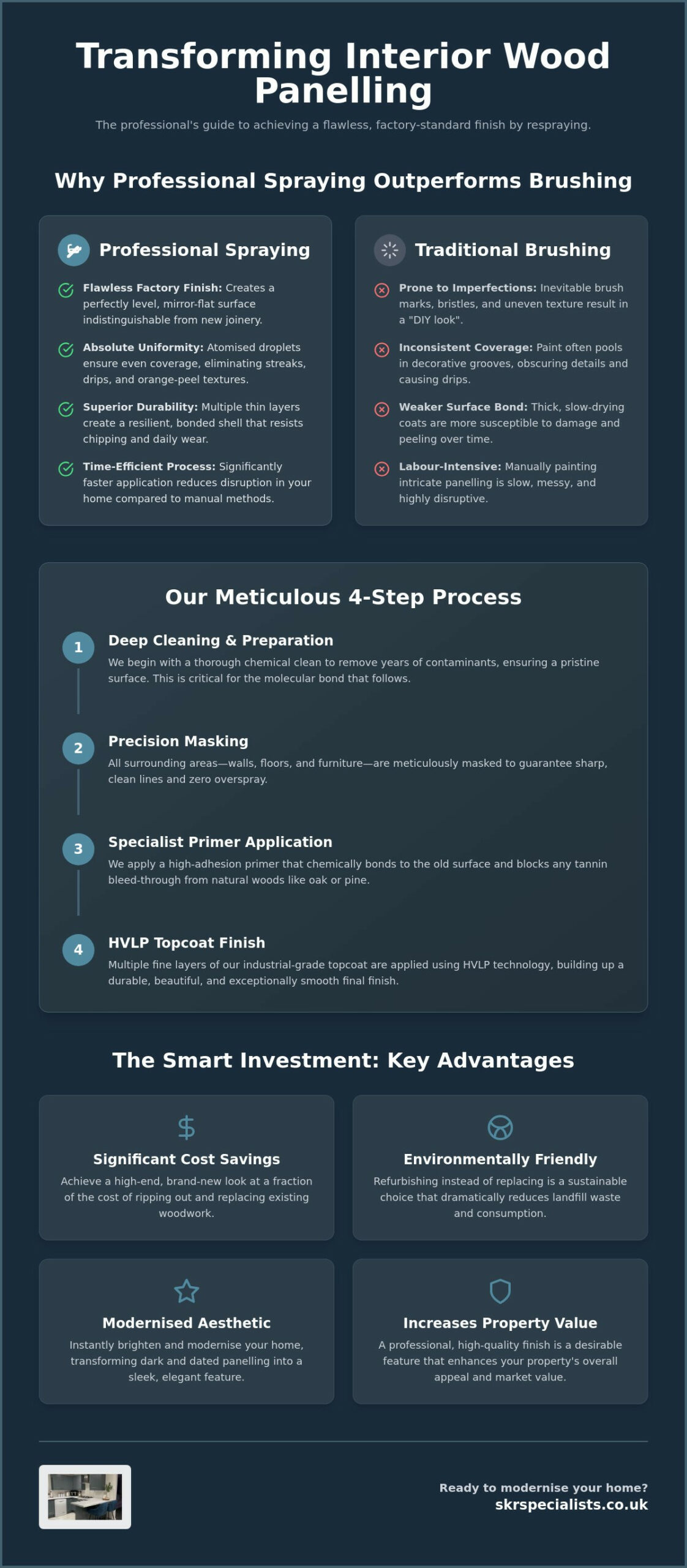
We follow a rigorous, five-stage protocol to ensure every project meets our exacting standards. Whilst DIY videos often suggest a quick blast of paint is sufficient, the reality of a professional finish lies in the hours of invisible work that precede the final spray. Our systematic approach ensures that the new coating doesn’t just look better; it performs better. We treat your woodwork with the same level of detail usually reserved for high-end automotive refinishing, moving from deep decontamination to the final blemish-free topcoat.
- Step 1: Deep chemical cleaning. We remove decades of accumulated household grease, wax, and silicon-based polishes. These contaminants are the primary cause of coating failure, so we eliminate them entirely before any paint touches the surface.
- Step 2: Precision masking. We protect every millimetre of your adjacent surfaces. This includes floors, ceilings, and electrical sockets, ensuring a sharp, clean line and zero overspray on your existing decor.
- Step 3: Multi-stage repair. We use specialist wood fillers to rectify dents, scratches, and open joints. This is followed by mechanical sanding with integrated dust-extraction equipment to create a perfectly level substrate.
- Step 4: High-build priming. We apply a specialist primer that fills the grain and provides a uniform base. We then fine-sand this layer by hand to achieve a glass-smooth surface that’s ready for the final colour.
- Step 5: Final topcoat. We apply the interior wood panelling spray paint in your chosen colour and sheen level, using multiple thin passes to ensure a deep, consistent finish.
Masking and Containment: Protecting Your Space
Professional masking is a technical discipline. We don’t just use standard tape; we employ advanced shielding systems and create custom “tents” using high-grade polythene. This containment, paired with industrial air extraction units, allows us to manage dust and fumes effectively within an occupied home. Our clean-site policy means we treat your property with respect, ensuring that the only evidence of our visit is your beautifully transformed woodwork. If you’re ready to experience this level of craftsmanship in your home, you can get a professional quote for your project today.
The Art of the Topcoat: Sheen and Durability
The final application of interior wood panelling spray paint is where the transformation becomes visible. Amongst UK designers, a satin sheen remains the perennial favourite for traditional panelling. It offers a sophisticated, subtle glow that hides minor imperfections whilst providing a surface that’s easy to clean. We “lay on” the final coat with overlapping passes, a technique that ensures absolute colour depth and prevents the “striping” often seen in amateur attempts. Once applied, the curing process begins. Surfaces are touch-dry quickly, but we recommend a 24-hour period before heavy use to allow the chemical cross-linking to reach its maximum hardness and durability.
Why Professional Respraying is the Smartest Investment for 2026
Choosing to refurbish rather than replace is the hallmark of a savvy property owner in 2026. Bespoke joinery is expensive to manufacture and even more costly to install. By opting for a professional respray, you retain the high-quality timber structures already present in your home whilst achieving an aesthetic that looks like a brand-new installation. This approach typically costs a fraction of the price of a full replacement, allowing you to reallocate your renovation budget to other areas of the property. It’s a value-driven decision that doesn’t compromise on the final, high-end result.
The environmental impact of this choice is significant. Refurbishing existing wood structures prevents perfectly functional materials from ending up in landfill. In an era where sustainability is a priority, restoring your current features with interior wood panelling spray paint is the most responsible way to modernise your space. We breathe new life into dark or dated timber, proving that you don’t need to destroy to innovate. It’s a cleaner, greener way to achieve a luxury interior, and for those in Scotland looking to further improve efficiency, ScotTherm Insulation offers specialised services to reduce energy waste.
Speed is another critical factor. A full structural renovation can turn your home into a building site for weeks. Our specialist team completes room transformations in a matter of days. We minimise the “disruption factor” through efficient masking and rapid application, getting your home back to normal without the dust and chaos of a demolition. You gain a new room without the typical renovation headache.
Durability That Outlasts Hand-Painting
The longevity of our finish is rooted in the use of hard-wearing industrial lacquers. These coatings are designed to resist chipping and scuffing in high-traffic areas, outperforming retail paints by a significant margin. Because the surface is perfectly smooth, it prevents dust and grime from bonding to the substrate, making your walls remarkably easy to clean. You can explore our data on is kitchen cabinet spraying durable to understand how these coatings perform over a ten-year period.
Maximising Property Value with Modern Finishes
A strategic colour change can completely alter the “feel” of a property, making it more appealing to potential buyers. A factory finish creates a “wow factor” that suggests a high-end architectural install rather than a simple redecoration. It signals to guests and buyers alike that the home has been maintained to an expert standard. We believe every property deserves a finish that reflects the quality of its bones. Contact SKR Specialists for a bespoke quote on your interior panelling project and discover the transformative power of a professional respray.
To complete your home’s transformation, you might also look for high-quality artwork to hang on your newly finished walls; learn more about First4Frames Gallery for a selection of fine art prints and bespoke framing options.
Revitalise Your Home with Precision Craftsmanship
Modernising your living space doesn’t have to involve the chaos of a full structural renovation. We’ve explored how the technical science of adhesion and specialist primers ensures that interior wood panelling spray paint provides a permanent, factory-standard upgrade. By choosing restoration over replacement, you secure a durable finish that resists daily wear whilst preserving the architectural character of your property. This approach is the smartest way to achieve a high-end aesthetic without the premium price tag of bespoke joinery.
Our specialist craftsmen bring automotive-grade precision to every project, offering a sophisticated alternative to traditional hand-painting. We provide national UK coverage, delivering factory-quality results that breathe new life into dated wood features. It’s time to move beyond the limitations of brushes and rollers to embrace a more refined, modern standard of home improvement. Transform your interior today with a professional respray quote from SKR Specialists. We look forward to helping you rediscover the beauty of your home.
Frequently Asked Questions
Can you spray paint over varnished wood panelling without sanding?
We avoid aggressive, heavy-handed sanding by using chemical etching and high-adhesion primers. Whilst a light mechanical “key” is sometimes necessary to ensure the coating latches onto the timber, our process relies on a molecular bond rather than deep abrasion. This approach preserves the delicate wood grain whilst providing a foundation that is far more secure than standard retail paint. It ensures the finish won’t peel or flake over time.
How long does professional interior wood panelling spray paint take to dry?
Our industrial coatings are typically touch-dry within 30 to 60 minutes of application. However, we recommend a 24-hour period before you resume heavy use of the room to allow the initial curing process to complete. The high-performance interior wood panelling spray paint we utilise continues to harden over several days, eventually reaching a level of chemical resistance that far exceeds traditional domestic emulsions.
Will the spray paint smell or linger in my home?
We utilise advanced air extraction units and high-grade containment “tents” to ensure any odours are managed effectively. Many of our specialist coatings are formulated to be low-VOC, often meeting stringent standards below 50 grams per litre. Any faint scent that remains during the application process dissipates rapidly with standard ventilation. Most homeowners find their rooms are perfectly comfortable to occupy just a few hours after we finish.
Is it better to spray or brush paint wood panelling?
Spraying is the definitive choice for anyone seeking a factory-grade finish without visible brush marks or lint. The atomisation process allows the interior wood panelling spray paint to settle into a perfectly level film, reaching deep into decorative mouldings where brushes often pool. It’s a faster, cleaner, and more precise method that results in a surface that looks manufactured rather than merely decorated.
Can you change the colour of very dark wood panelling to a light shade?
We can transform even the darkest mahogany or oak into a crisp, light shade using specialist tannin-blocking primers. These chemical barriers prevent the natural oils in the wood from bleeding through and yellowing the new finish. This technical step is vital for a successful colour transition, ensuring your new white, cream, or light grey remains vibrant and pure for years to come.
How much does it cost to professionally respray wood panelling in the UK?
The investment for a professional respray depends on the total surface area, the complexity of the mouldings, and the material of your panelling. Every project is unique, so we provide bespoke quotes based on the specific requirements of your home. Choosing to respray is a highly cost-effective alternative to full replacement, as it avoids the high labour costs and waste associated with bespoke joinery and structural removal.
Does sprayed paint on wood panelling chip easily?
No, our industrial lacquers are specifically engineered for high-traffic durability and impact resistance. Unlike brittle shop-bought paints, these coatings feature advanced chemical cross-linking that creates a resilient, flexible shell. This bond allows the woodwork to withstand the knocks of daily life without chipping or scuffing. It provides a long-lasting surface that maintains its aesthetic integrity far better than traditional hand-painted alternatives.
Can I stay in my house whilst the wood panelling is being sprayed?
You can certainly remain in your property whilst our technicians are at work. We use precision masking and extraction systems to contain the workspace and protect your belongings from overspray. Whilst we recommend avoiding the specific room being treated during the active spraying and drying phases, the rest of your home remains fully accessible. Our efficient process ensures we complete the transformation with minimal disruption to your daily routine.