
Spray Guns: Key to Flawless Kitchen Resprays
Finding the right way to give your kitchen a fresh, flawless look can be surprisingly challenging when every detail matters. For many homeowners across England, the secret lies in using a spray gun to achieve that sought-after factory-quality finish. Unlike brushes or rollers, spray guns atomise paint into fine droplets, making it possible to cover your cabinets smoothly and efficiently while cutting down on paint waste and labour. This guide demystifies how spray guns work, their key benefits, and what to look for when choosing the right tool for your kitchen refurbishment.
Table of Contents
- What Is a Spray Gun and Its Purpose
- Types of Spray Guns Used in Kitchens
- How Spray Guns Deliver a Factory Finish
- Benefits Over Traditional Painting Methods
- Common Mistakes and How to Avoid Them
Key Takeaways
| Point | Details |
|---|---|
| Spray Guns Enhance Efficiency | Spray guns significantly reduce painting time and paint wastage while providing a consistent, professional-grade finish. |
| Types of Spray Guns Matter | Choosing the right spray gun type, such as HVLP, electrostatic, or compressed air, is crucial for optimal results based on surface characteristics. |
| Proper Technique is Essential | Mastering spray gun settings and technique through practice on scrap material ensures a flawless finish and avoids common mistakes. |
| Safety First | Always use appropriate personal protective equipment to mitigate health risks associated with paint spraying and ensure a safe working environment. |
What Is a Spray Gun and Its Purpose
A spray gun is a precision engineering tool designed to transform liquid paint into fine, evenly distributed droplets, enabling professional painters and DIY enthusiasts to achieve seamless surface coverage. Developed as an advanced alternative to traditional painting methods, spray guns represent a significant technological leap in surface finishing techniques.
The primary purpose of a spray gun is to atomise paint efficiently, breaking liquid coatings into microscopic particles that create an ultra-smooth, uniform finish. Unlike brushes or rollers which can leave visible stroke marks and uneven layers, spray guns deliver a factory-grade result with remarkable consistency. They work by using compressed air to break paint into fine droplets, which are then propelled onto surfaces with precision and control.
Modern spray guns offer multiple advantages for kitchen respraying projects, including:
- Significantly reduced painting time
- Minimal paint wastage
- Consistent paint distribution
- Ability to cover complex surface geometries
- Professional-grade finish with minimal effort
Pro tip: Always test your spray gun’s settings on a scrap surface before beginning your main painting project to understand its spray pattern and adjust accordingly.
Types of Spray Guns Used in Kitchens
Kitchen respraying requires specialised spray gun technology to achieve professional-grade finishes. Professional painters and kitchen renovation experts typically utilise three primary types of spray guns, each designed to address specific painting requirements and surface characteristics.
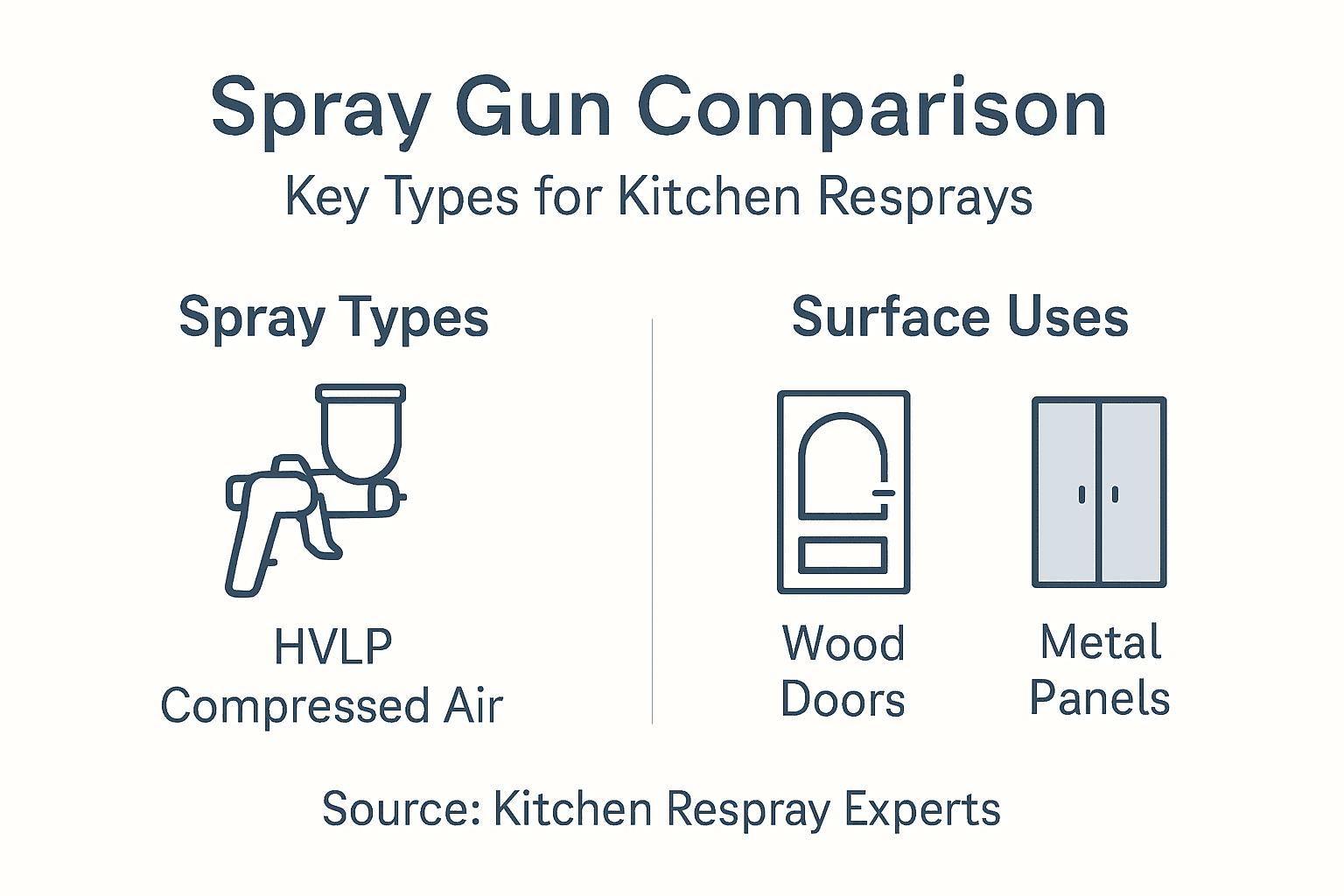
The first category is High Volume Low Pressure (HVLP) spray guns, which are widely recognised for their exceptional precision and minimal paint waste. These guns operate by using a high volume of air at low pressure, allowing for meticulous paint application that reduces overspray and ensures maximum paint transfer efficiency. HVLP guns are particularly suited to kitchen cabinet respraying, where detailed and controlled paint coverage is essential.
Second, electrostatic spray systems represent an advanced technological approach to surface painting. These sophisticated tools charge paint particles electrically, causing them to be attracted to grounded surfaces with remarkable uniformity. This unique characteristic enables paint to wrap around edges and complex surfaces, creating an incredibly even coating that traditional spray methods cannot achieve. They are especially effective for kitchen units with intricate designs or multiple surface angles.
The third category includes compressed air spray guns, which remain popular among professional painters for their versatility. These traditional tools use compressed air to atomise paint, offering robust performance across various paint viscosities and surface types. While they might produce more overspray compared to HVLP systems, they provide excellent coverage for larger kitchen renovation projects.
Pro tip: Always match your spray gun selection to your specific kitchen surface material and desired finish to achieve optimal painting results.
Here is a comparison of the main spray gun types commonly used for kitchen respraying:
| Spray Gun Type | Best Application | Paint Control Level | Surface Suitability |
|---|---|---|---|
| HVLP | Cabinet detailing | Excellent precision | Wood, MDF, and laminate |
| Electrostatic System | Complex surfaces | Highly uniform coverage | Intricate or contoured units |
| Compressed Air | Large surface areas | Versatile, moderate | Flat and varied materials |
How Spray Guns Deliver a Factory Finish
Achieving a flawless, professional-grade kitchen finish requires precision engineering and advanced painting techniques that transform ordinary surfaces into extraordinary spaces. Spray guns represent the pinnacle of surface finishing technology, delivering results that far exceed traditional painting methods through sophisticated atomisation and application processes.
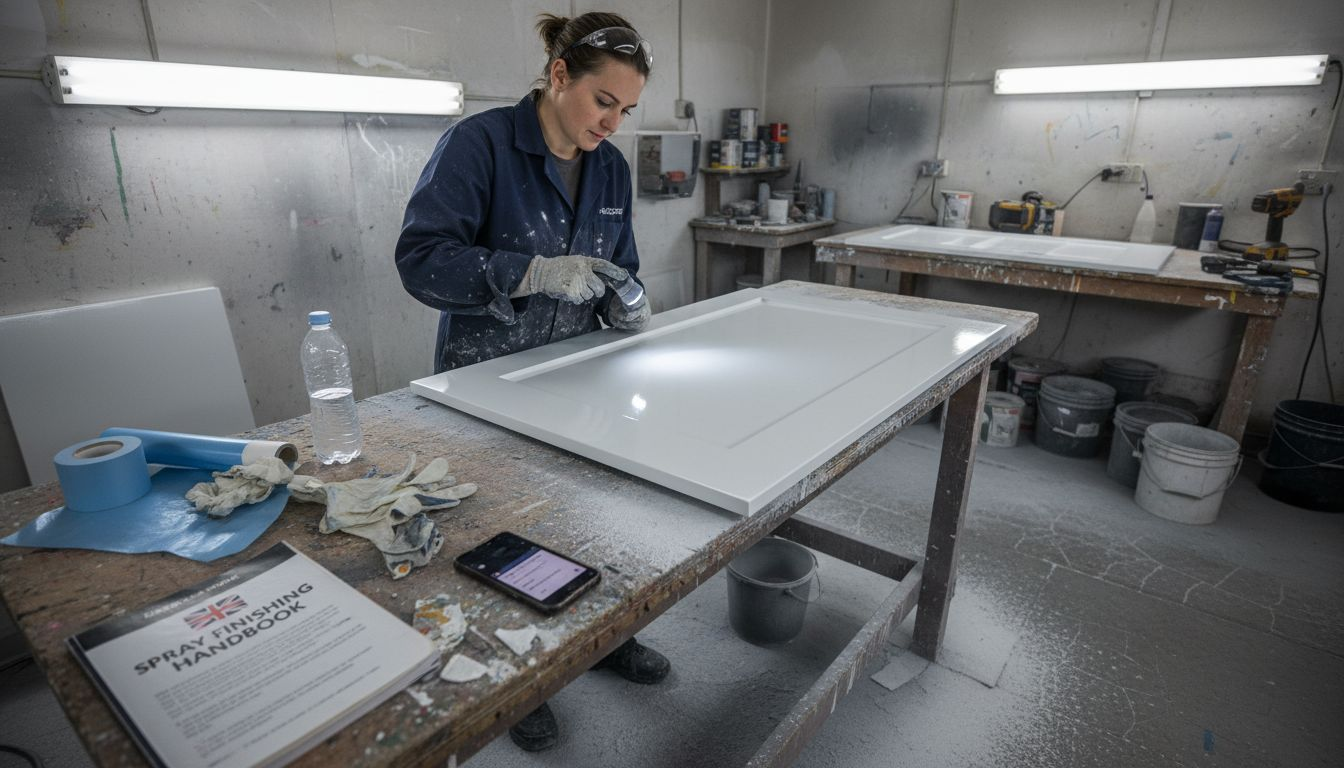
The key to a factory-level finish lies in the spray gun’s ability to break down paint into microscopic droplets, creating an ultra-smooth, uniform coating. By generating exceptionally fine paint particles, these tools ensure that paint is distributed with mathematical precision, eliminating common imperfections like brush marks, roller streaks, and uneven coverage. The controlled paint droplet size allows for an almost imperceptible layer application, mimicking the perfection of industrial manufacturing processes.
Modern spray guns achieve this remarkable finish through several critical mechanisms:
- Atomisation technology that breaks paint into tiny, uniform droplets
- Precise air pressure control to manage paint distribution
- Advanced nozzle engineering that ensures consistent spray patterns
- Electrostatic charging in advanced systems to improve paint adhesion
- Rapid and even application that reduces human error
Unlike traditional painting methods that rely on manual techniques, spray guns create a molecular-level approach to surface coating. The compressed air and specialised nozzle design work in harmony to create a finish so smooth and consistent that it appears to have been applied in a controlled factory environment. This technological marvel transforms kitchen surfaces from ordinary to extraordinary, providing homeowners with a professional-grade aesthetic that was previously achievable only through industrial manufacturing processes.
Pro tip: Practice your spray gun technique on sample boards before tackling your kitchen units to master the perfect distance, angle, and movement for a flawless finish.
Benefits Over Traditional Painting Methods
Traditional painting methods using brushes and rollers have long been the standard approach for kitchen renovations, but spray gun technology represents a revolutionary leap in surface finishing techniques. The limitations of manual painting techniques become glaringly apparent when compared to the precision and efficiency of modern spray gun applications.
Spray guns offer remarkable advantages that fundamentally transform the painting process. Reducing physical labour dramatically, these sophisticated tools eliminate the tedious manual work associated with traditional painting. Unlike brushes and rollers that require repetitive arm movements and create uneven surfaces, spray guns deliver consistent coverage with minimal physical strain, making them particularly beneficial for extensive kitchen renovation projects.
The technical superiority of spray guns becomes evident through multiple performance metrics:
- Faster application compared to brush and roller techniques
- Superior surface coverage reaching complex geometries
- Minimal paint wastage through precise atomisation
- Smoother, more uniform finish without brush marks
- Reduced physical effort for painters and DIY enthusiasts
Moreover, spray guns excel in addressing challenging surface requirements that traditional methods struggle to manage. Their ability to create thin, even coats means kitchen cabinets can achieve a factory-like finish with unprecedented ease. The technology allows for seamless coverage of intricate details, corners, and hard-to-reach areas that brushes and rollers typically miss, ensuring a professional-grade result that elevates the entire kitchen aesthetic.
Pro tip: Invest in high-quality painter’s tape and plastic sheeting to protect surrounding areas when using spray guns, ensuring a clean and precise painting environment.
Common Mistakes and How to Avoid Them
Spray gun usage requires precision and understanding, with numerous potential pitfalls that can compromise both the quality of your kitchen respray and personal safety. Professional painters and DIY enthusiasts alike must navigate a complex landscape of technical challenges and potential errors that can significantly impact the final result.
Selecting appropriate personal protective equipment represents one of the most critical safety considerations when using spray guns. Many inexperienced users neglect proper respiratory protection, exposing themselves to harmful paint particles and potentially dangerous chemical vapours. Wearing CE or UKCA marked respiratory masks, safety goggles, and disposable coveralls is essential to prevent potential health risks associated with paint spraying.
Common mistakes that can compromise your kitchen respray project include:
The table below summarises common mistakes in kitchen spray painting and how to avoid them:
| Mistake | Risk or Problem | How to Prevent |
|---|---|---|
| Inadequate surface preparation | Poor paint adhesion, peeling | Thorough cleaning and sanding |
| Incorrect spray distance | Uneven or patchy coating | Test and adjust nozzle range |
| Improper paint viscosity | Drips or insufficient coverage | Check and mix paint properly |
| Poor ventilation | Health risks, paint odour build-up | Open windows, use fans |
- Inadequate surface preparation leading to poor paint adhesion
- Incorrect spray gun distance causing uneven coating
- Inappropriate paint viscosity resulting in drips or thin coverage
- Neglecting ventilation creating potential health hazards
- Inconsistent spray gun movement producing patchy finishes
Technical proficiency is crucial in avoiding spray painting errors. Understanding your equipment’s specific settings, maintaining proper spray gun technique, and creating a well-ventilated workspace are fundamental to achieving a professional-grade kitchen respray. Each mistake can potentially compromise hours of careful work, transforming what should be a precision operation into a frustrating experience.
Pro tip: Practice your spray technique on cardboard or scrap material to develop muscle memory and understand your specific spray gun’s unique characteristics before attempting your kitchen respray.
Achieve Flawless Kitchen Resprays with Expert Spray Gun Technology
If you are seeking a professional kitchen respray that delivers a factory-quality finish, understanding the power of spray gun technology is key. From precise paint atomisation to consistent coverage over complex surfaces, spray guns solve common challenges like uneven coatings and paint wastage. At SKR Specialists, we bring this advanced technique directly to your home with in-situ kitchen respraying that eliminates the guesswork and mess.

Transform your kitchen with confidence by choosing our expert team. We carefully select and operate the ideal spray gun systems suited to your kitchen’s unique surfaces, ensuring minimal disruption and a flawless finish. Discover why homeowners rely on us to achieve perfect results every time. Visit our main site, explore how we deliver precision painting solutions, and book your consultation today to bring the best of spray gun technology to your kitchen upgrade.
Frequently Asked Questions
What types of spray guns are best for kitchen respraying?
Modern spray guns suitable for kitchen respraying include High Volume Low Pressure (HVLP) spray guns for detailed finishes, electrostatic spray systems for complex surfaces, and compressed air spray guns for larger areas. Each type has unique advantages tailored to different painting needs.
How does a spray gun deliver a factory finish?
A spray gun achieves a factory-level finish by atomising paint into microscopic droplets, ensuring an ultra-smooth and uniform coating. Key factors include precise air pressure control, advanced nozzle design, and controlled spray patterns that eliminate brush marks and uneven coverage.
What are the benefits of using a spray gun over traditional painting methods?
Spray guns offer faster application, superior surface coverage, minimal paint wastage, and an overall smoother finish compared to traditional brushes and rollers. They significantly reduce physical labour while achieving professional-grade results, especially for intricate surfaces.
What common mistakes should I avoid when using a spray gun?
Common mistakes include inadequate surface preparation, incorrect spray gun distance, improper paint viscosity, neglecting ventilation, and inconsistent movement. To prevent these issues, ensure proper cleaning, test settings, use the right paint consistency, improve airflow, and practice your technique beforehand.