
Spraying Laminate Kitchen Cabinets: The Professional Guide to a Factory Finish in 2026
The most expensive mistake you can make with a dated kitchen is assuming the only way to modernise it is to rip everything out and start again. It’s frustrating to live with worn, faded surfaces, yet the thought of a full renovation often feels like too much disruption and expense. You’ve likely heard that spraying laminate kitchen cabinets is a risky move. If you’re thinking about using a brush and a tin of retail paint, you’re probably right. Laminate is notoriously non-porous, making it a nightmare for standard DIY applications where peeling and chipping are almost guaranteed.
However, there’s a smarter way to achieve a high-end aesthetic without the structural upheaval. We’ll show you how the specialist science of chemical cross-linking and professional atomisation creates a durable, factory-smooth finish that breathes new life into your home. This guide explores the essential bonding primers needed for permanent adhesion, the shift toward matte finishes and earthy ‘greige’ colour tones for 2026, and why a professional respray is the ultimate value-driven alternative to replacement.
Key Takeaways
- Understand why successful laminate restoration depends on creating a molecular bond rather than surface absorption to ensure the finish never peels.
- Identify the technical reasons why most DIY projects fail and how professional-grade degreasing prevents the “invisible” grease that ruins adhesion.
- Learn how high-precision atomisation and controlled film thickness provide a factory-quality finish that hand-painting cannot match.
- Explore how spraying laminate kitchen cabinets provides a durable, high-end transformation in just a few days with minimal home disruption.
- Recognise the importance of mechanical abrasion to create a physical “key” for the coating without compromising the integrity of the laminate core.
Can You Spray Paint Laminate Kitchen Cabinets? The Science of Adhesion
Many homeowners ask if spraying laminate kitchen cabinets is a viable long-term solution. The answer is a definitive yes, but only when you move beyond the concept of “painting” and into the science of coating technology. Specialist respraying involves applying a high-performance, industrial-grade coating to non-porous melamine or laminate surfaces. To understand why this requires a specific technical approach, we first need to ask: What is Laminate? Essentially, it’s a dense composite of paper and resin, finished with a hard, plastic-like wear layer designed specifically to repel liquids and stains.
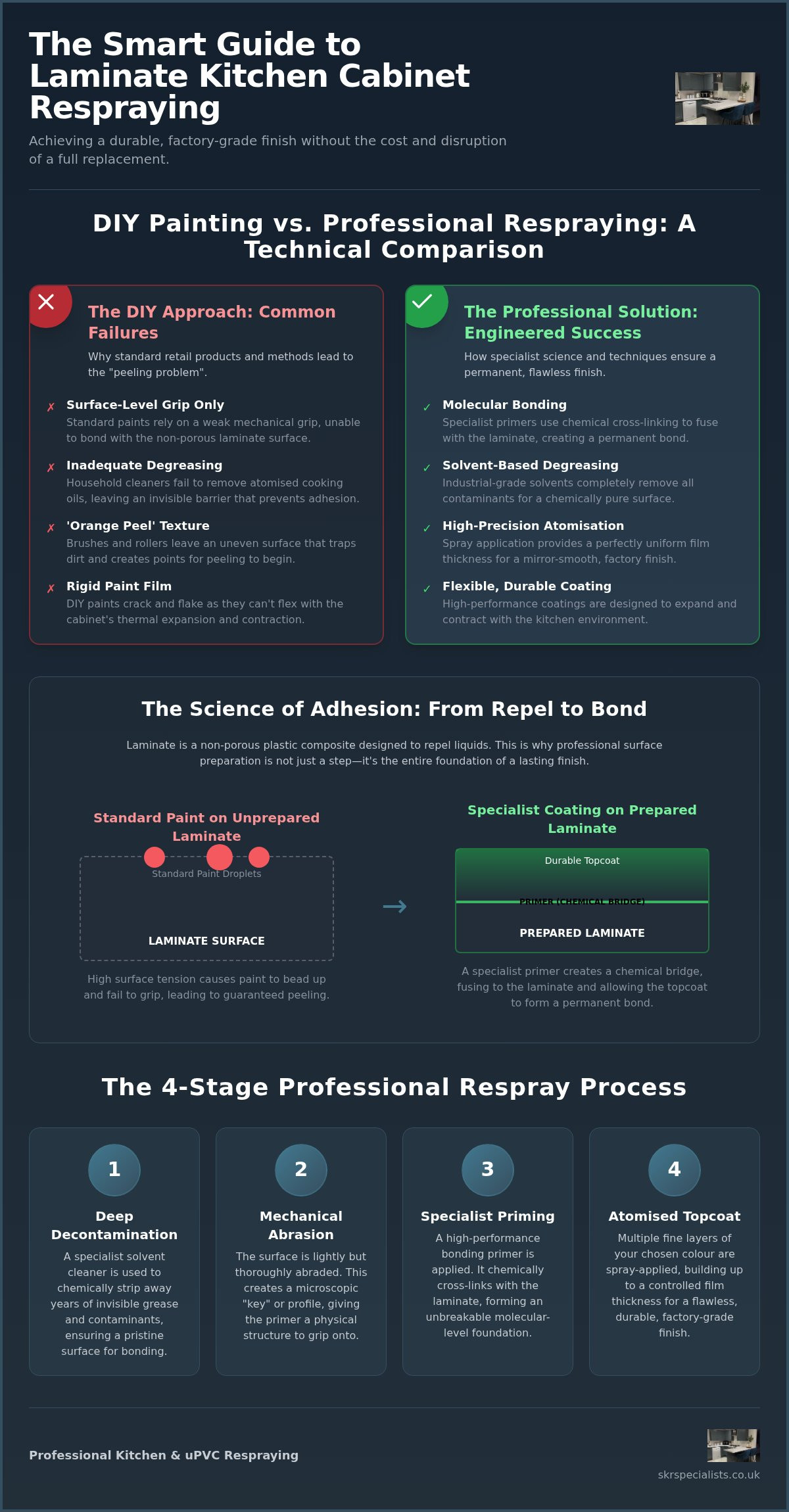
Laminate is unique because it lacks the cellular structure of timber. Whilst wood “drinks” paint, laminate is chemically inert and incredibly slick. This creates high surface tension that causes standard retail liquids to bead and roll off rather than penetrate. Professional deglossing agents are used to chemically alter this slick layer, breaking down the surface tension to prepare it for a molecular bond. Laminate respraying is a chemical bonding process rather than a mere aesthetic covering.
Laminate vs. Melamine: Understanding Your Cabinets
Most UK kitchens feature either High-Pressure Laminate (HPL) or Melamine-Faced Chipboard (MFC). HPL is thicker and more durable, often found on worktops or premium doors, whilst MFC is the standard for most modern cabinetry carcasses and flat-panel doors. Both materials share a non-porous plastic exterior that makes them difficult for general trade paints to grip. This slickness dictates the need for professional spray systems that can atomise coatings finely enough to achieve a uniform, factory-quality finish without the sagging or pooling common with brushes and rollers.
The Molecular Bond: Why Standard Paint Fails
Retail “all-in-one” paints usually fail on laminate because they rely on a simple mechanical grip. In a kitchen environment, where heat from ovens and moisture from kettles are constant, these coatings expand and contract at different rates than the plastic beneath. This leads to the “peeling effect” where the paint eventually detaches in large flakes. Spraying laminate kitchen cabinets professionally solves this by using specialist primers that act as a chemical bridge. These primers utilise cross-linking technology to fuse with the laminate at a molecular level, creating a foundation that is as resilient as the original factory finish. This ensures your kitchen remains durable amongst the daily rigours of a busy household.
Why Most DIY Laminate Painting Projects Fail: The Peeling Problem
The internet is littered with cautionary tales of DIY kitchen makeovers that looked stunning on day one but began to flake by month six. This phenomenon, often called the ‘peeling problem’, isn’t down to bad luck. It’s the result of fundamental technical oversights. When spraying laminate kitchen cabinets, the margin for error is microscopic. If you can perform the ‘fingernail test’, which involves scraping the surface with moderate pressure, and the coating lifts, the bond has failed at the primer level. This failure is usually rooted in the invisible environment of a working kitchen.
DIYers often resort to foam rollers or brushes, which inevitably create an ‘orange peel’ texture. This isn’t just an aesthetic issue. These tiny craters trap dirt and grease, creating leverage points where the paint can begin to lift and tear. Achieving a factory finish requires removing these mechanical variables entirely.
The Role of Proper Degreasing
Inadequate cleaning is the primary reason for delamination. Standard washing up liquid is designed for plates; it isn’t potent enough to neutralise the industrial-grade cooking oils that atomise and settle on your cabinets over years of use. These oils create an invisible barrier between the laminate and the paint. Professional craftsmen use specialist solvent cleaners to ensure a chemically pure surface. Without this level of decontamination, even the most expensive retail paint will simply sit on top of the grease, destined to slide off within weeks.
Thermal Expansion and Contraction
British kitchens endure significant swings in humidity and temperature. Kettles boiling and ovens preheating cause the underlying substrate to expand. Whilst wood is somewhat flexible, the laminate and the chipboard core react differently to heat. Standard DIY paints are often too rigid; they don’t move with the cabinets. This leads to micro-cracks amongst the joints and edges, allowing moisture to seep in and blow the finish from the inside out. Choosing a professional kitchen respray ensures you’re using coatings engineered to flex alongside these thermal shifts.
Professional Spraying vs. Hand Painting: A Technical Comparison
Choosing between a brush and a spray gun isn’t just about speed; it’s about the fundamental physics of how the coating sits on the substrate. When spraying laminate kitchen cabinets, professionals rely on atomisation. This process breaks the coating down into a fine, consistent mist of microscopic droplets. Unlike a brush, which drags paint across the surface and leaves visible ridges, atomisation allows the droplets to knit together into a perfectly level film. This level of precision is impossible to replicate by hand, especially on non-porous surfaces where every stroke mark is magnified.
Film thickness is equally critical. A hand-applied layer of retail paint is often too thick and uneven, leading to sagging and poor curing. Professional application involves building up multiple ultra-thin layers. This creates a cohesive, high-density shell that is far more resistant to impact than a single heavy coat. Whilst high-street ‘cupboard paints’ are generally simple acrylics, professional services utilise advanced polyurethane-acrylic blends. These industrial coatings are engineered for hardness and chemical resistance. A professional respray offers a 10-year lifespan whilst hand painting typically fails within a single year.
The ‘Factory Finish’ Explained
Cost-Efficiency and Longevity
Many homeowners initially lean towards DIY to save money, but the return on investment (ROI) tells a different story. The hidden costs of tools, high-quality primers, and the inevitable time spent correcting mistakes quickly add up. If the bond fails, the cost of professional correction is significantly higher because the failed DIY layer must be stripped back entirely. Investing in an expert service ensures the job is done once and done correctly. You can learn more about the technical endurance of these coatings by reading Is Kitchen Cabinet Spraying Durable? to understand how these systems stand the test of time.
The Step-by-Step Professional Respray Process for Laminate
Achieving a durable finish requires more than just a steady hand; it demands a disciplined, multi-stage workflow. Our process begins with the complete disassembly of your kitchen. We remove all handles, hinges, and hardware to ensure every centimetre of the cabinet face is accessible. Following the surgical-grade cleansing mentioned earlier, we move to mechanical abrasion. This isn’t aggressive sanding that damages the chipboard core. Instead, we use fine-grit abrasives to ‘scuff’ the surface, creating a microscopic physical key that allows the primer to lock into the laminate.
Protecting your home is our priority. We create a temporary ‘cleanroom’ environment by masking every surface that isn’t being sprayed. This includes worktops, floors, and appliances, ensuring zero overspray or dust contamination. When spraying laminate kitchen cabinets, we apply the coating in a controlled sequence of thin, high-atomisation passes. This includes the high-adhesion primers and industrial topcoats that provide the final factory finish. Once the application is complete, the curing phase begins. This is a vital hardening period where the chemicals cross-link to reach their maximum durability before the kitchen returns to full use.
Advanced Priming Techniques
Standard primers often slide off slick plastics. We utilise specialist acid-catalyst or shellac-based primers specifically engineered for maximum grip on non-porous substrates. A critical part of this stage is managing ‘flash-off’ times. This is the precise window where solvents evaporate, allowing the coating to stabilise before the next layer is applied. We also address common laminate issues like loose edge-banding or minor peeling. By securing these elements before the primer hits the surface, we ensure the final result is structurally sound and aesthetically perfect.
The Final Topcoat: Selecting Your Sheen
The final aesthetic choice is yours. Modern kitchen resprays offer a range of sheens, from ultra-matt to high gloss. Most homeowners in 2026 are opting for soft-touch matt finishes, which are exceptionally good at hiding fingerprints and resisting UV yellowing. These coatings are formulated to withstand common household chemicals and the rigours of daily cleaning. To explore your options in more detail, see our guide on The Best Finish for Kitchen Cabinets. If you’re ready to begin your transformation, you can request a professional kitchen unit respray today.
Transforming Your Kitchen with SKR Specialists’ Professional Respray
Choosing the right partner for your renovation is as critical as the technical process itself. At SKR Specialists, we approach spraying laminate kitchen cabinets with a level of detail honed in high-precision technical trades. Our background in automotive-grade paint finishing means we don’t just “paint” units; we restore them to a standard that rivals original manufacturer quality. We understand that your kitchen is the heart of your home. That’s why our service is designed to be as seamless and disruption-free as possible, allowing you to reclaim your space without the headache of a building site.
Most of our transformations are completed in just a few days. Compare this to the weeks of chaos, dust, and plumbing disconnection required for a full replacement. By choosing to refresh your existing cabinetry, you’re also making a savvy environmental choice. Every year, thousands of tonnes of perfectly functional kitchen carcasses end up in UK landfills simply because their laminate faces have dated. Our restoration process keeps these materials in use whilst providing you with a modern, high-end aesthetic that feels entirely new.
Why Property Owners Trust Our Expertise
We’ve built our reputation as expert craftsmen by prioritising technical precision over rapid turnover. Our national coverage ensures that homeowners across the UK have access to specialised respraying that goes far beyond the capabilities of general domestic painters. We provide the peace of mind that comes with a factory-grade finish, ensuring your investment is protected by a coating that is as durable as it is beautiful. We’re disruptors in the industry, openly challenging the necessity of expensive structural remodels when a professional surface renewal offers superior value and a sharper result.
Request Your Transformation Quote
Getting started is simple and reflects our modern, digital-first approach. We don’t require lengthy site visits for initial estimates. By providing us with a few clear photos of your current kitchen, our team can offer immediate feedback and a rapid, accurate pricing guide. During your consultation, we’ll walk you through the colour-matching process, helping you select the perfect earthy tone or contemporary matt finish for 2026. If you’re ready to experience the relief of a high-quality, value-driven kitchen update, Contact SKR Specialists for your bespoke kitchen respray quote and let us handle the renewal of your space.
Secure Your High-End Kitchen Transformation
Laminate doesn’t have to be a permanent aesthetic hurdle. By understanding that spraying laminate kitchen cabinets is a technical chemical process rather than a simple paint job, you can unlock a high-end transformation at a fraction of the cost of replacement. We’ve explored how professional atomisation and automotive-grade precision create a bond that resists the heat and moisture of a busy British home. You don’t have to settle for the peeling risks of DIY or the disruption of a full renovation.
SKR Specialists provide a national UK specialist service, bringing a background in high-precision trades to every project. We ensure a durable factory finish that breathes new life into your space whilst keeping functional materials out of landfill. It’s time to choose the smarter, modern alternative for your property. We look forward to helping you achieve the kitchen you’ve always wanted with zero stress and total confidence.
Get a professional quote for your laminate kitchen respray today
Frequently Asked Questions
Can you really spray paint over shiny laminate cabinets?
Yes, you can successfully spray over shiny laminate cabinets by using professional deglossing agents and bonding primers. High-gloss laminate is designed to repel liquids, so a standard coat of paint will simply bead on the surface. We use industrial-grade chemicals to neutralise this slick layer, creating a receptive foundation for the coating. This ensures the finish is as permanent as the original factory surface.
How long does a professional laminate respray last compared to DIY?
A professional respray typically lasts upwards of 10 years, whereas DIY attempts often begin to peel within a single year. The difference lies in the equipment and materials used. Whilst DIYers rely on retail acrylics, specialists use polyurethane-acrylic blends and HVLP spray systems. These industrial coatings are engineered to withstand the daily rigours of a busy kitchen without flaking or losing their sheen.
Will the paint peel off the laminate near the oven or sink?
No, the coating won’t peel near heat sources or sinks if it’s been applied using professional cross-linking technology. We use primers and topcoats specifically formulated to expand and contract alongside the substrate. This thermal stability prevents the micro-cracking that often leads to delamination in high-moisture areas. It’s a robust solution for the most demanding zones of your kitchen.
Is it better to spray or wrap laminate kitchen cabinets?
Spraying is generally the superior choice for long-term durability and a seamless aesthetic. Vinyl wraps often peel at the edges when exposed to heat from kettles or ovens, a common issue known as “shovelling”. Spraying laminate kitchen cabinets creates a unified, liquid-applied shell that covers every intricate moulding and edge without the risk of lifting or bubbling over time.
Do I need to empty my cupboards before the specialists arrive?
You don’t need to empty the contents of your cupboards, as we only remove and spray the external doors and drawer fronts. We ask that you clear your worktops to allow our team to mask the area effectively. This “cleanroom” setup ensures your belongings remain protected whilst we focus on the visible surfaces. It’s a low-disruption process that keeps your kitchen functional throughout the transformation.
How much does it cost to have laminate kitchen cabinets professionally sprayed in the UK?
The cost of a professional respray depends on the size and complexity of your kitchen, though it’s consistently a fraction of the cost of a full replacement. Industry data suggests that a complete kitchen remodel can exceed £15,000, whereas a specialist respray offers a similar visual result for a much smaller investment. We provide bespoke estimates based on photos of your specific layout to ensure accuracy.
Can you change the colour of dark laminate to a lighter shade successfully?
Yes, changing from dark woodgrains or navy blues to lighter shades like “greige” or off-white is entirely successful with professional equipment. We use high-opacity primers that completely neutralise the underlying colour in just one or two passes. This ensures the new shade is vibrant and consistent across all units, with no “ghosting” or dark patches visible through the final factory-smooth topcoat.
What is the best type of paint to use on laminate surfaces for a factory finish?
The best material for a factory finish on laminate is a two-part polyurethane-acrylic blend. These industrial coatings offer the perfect balance of flexibility and hardness. Unlike standard water-based retail paints, these blends are designed for spraying laminate kitchen cabinets to provide high impact resistance and a smooth, non-porous surface that is easy to clean and maintain for years to come.