
Updating Wood Kitchen Cabinets with Paint: The Professional 2026 Guide
Tearing out your entire kitchen just because the solid wood has turned a stubborn shade of orange is a costly mistake that savvy homeowners no longer need to make. You’ve likely spent years staring at yellowing units, perhaps even worrying that updating wood kitchen cabinets with paint will result in a messy, peeling finish that looks like a cheap DIY project. It’s a common fear; your kitchen is the high-traffic heart of your home, and you need a durable surface that can actually withstand the rigours of daily family life.
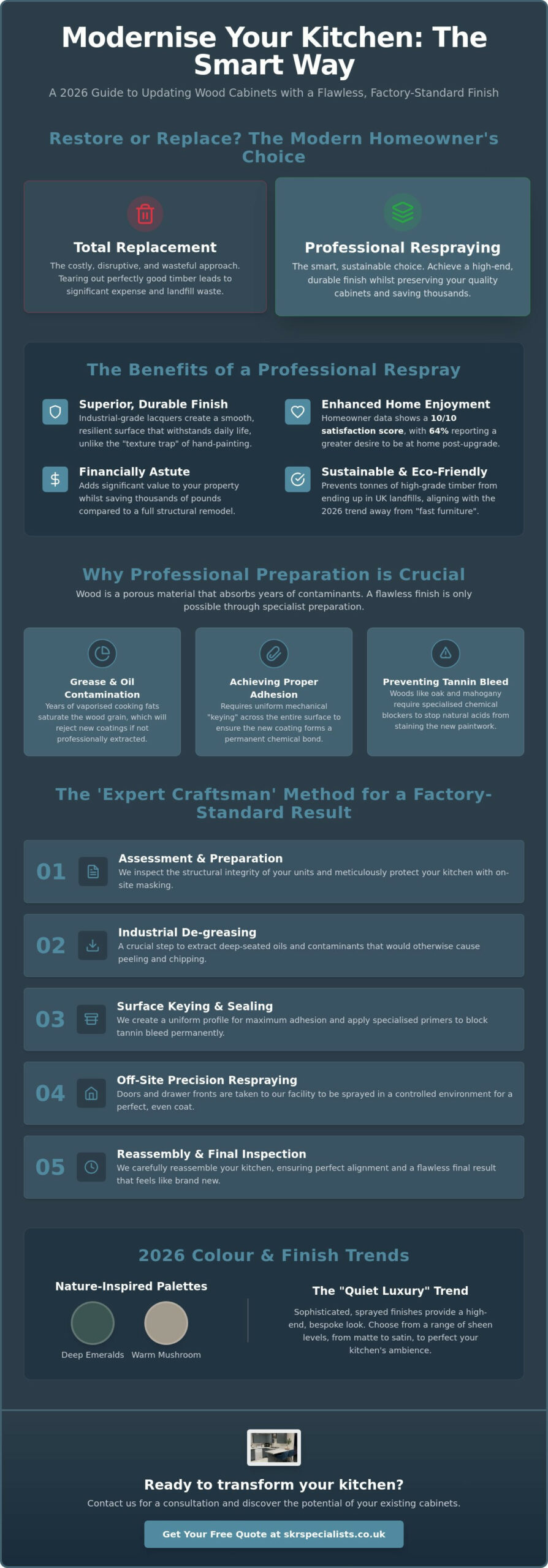
We’re here to tell you that a total replacement isn’t the only path to a modern home. You can achieve a smooth, factory-standard masterpiece that feels like high-end furniture without the overwhelming mess or expense of a structural renovation. This professional 2026 guide reveals the technical precision required to create a flawless, showroom finish. We’ll explore the latest nature-inspired colour palettes, from deep emeralds to warm mushroom tones, and explain why a specialised respray is the smartest, most efficient way to breathe new life into your cabinetry.
Key Takeaways
- Learn how updating wood kitchen cabinets with paint preserves the integrity of your timber units whilst avoiding the cost and chaos of a full replacement.
- Identify the technical preparations required to stop tannin bleed and grease saturation from compromising your cabinetry’s new surface.
- Compare the “texture trap” of hand-painting against the smooth, resilient finish of industrial-grade lacquers used in professional respraying.
- Find out which 2026 colour palettes and sheen levels are best suited for modernising traditional wood grains into high-end features.
- Discover the meticulous “Expert Craftsman” method for achieving a factory-standard result through a combination of on-site protection and off-site precision.
The Potential of Updating Wood Kitchen Cabinets with Paint in 2026
A flawless, showroom finish is achievable without the disruption of a full kitchen rip-out. Updating wood kitchen cabinets with paint is a meticulous restoration process that goes far beyond a simple aesthetic change. It involves a systematic approach of industrial-strength de-greasing, structural repairs, and high-precision re-coating of existing timber units. Whilst many homeowners consider total replacement the only solution for a dated kitchen, the reality is that solid wood is a far superior substrate than modern, mass-produced alternatives. High-quality timber provides a stable, durable foundation that absorbs professional wood finishing techniques with far greater success than cheap MDF.
Choosing restoration over replacement isn’t just a financial decision; it’s an environmental one. By retaining your existing cabinetry, you prevent tonnes of high-grade material from entering UK landfills. This restoration approach is backed by homeowner data; kitchen upgrades consistently earn a 10/10 satisfaction score according to 2026 research, with 64% of people reporting a greater desire to be at home after the project. Beyond the ethics, the architectural impact is profound. A strategic colour change can completely redefine the light and flow of your kitchen, making a cramped space feel expansive or a cold room feel intimate.
Why 2026 is the Year of the Sustainable Kitchen
The shift away from “fast furniture” has reached a peak in 2026. Homeowners now prioritise longevity and craftsmanship over disposable convenience. Updating wood kitchen cabinets with paint aligns perfectly with the “quiet luxury” trend, where sophisticated, sprayed finishes provide a high-end look that feels bespoke. This approach adds significant value to UK properties whilst saving thousands compared to a structural remodel. It’s the savvy choice for those who value both aesthetic excellence and fiscal responsibility.
Assessing Your Cabinetry: Is Your Wood Suitable?
Most timber units are ideal candidates for a professional respray. Whether you have solid oak or high-quality wood veneer; both respond exceptionally well to specialised coatings once the surface is correctly prepared. Before beginning, we check for structural integrity and ensure door alignment is precise. That “dated” orange oak or knotty pine is actually a goldmine for a modern transformation. Once the grain is sealed and the colour is modernised, these units often look superior to expensive new installations. This meticulous Expert Craftsman approach ensures that your existing kitchen becomes a high-end masterpiece.
The Technical Challenge: Why Wood Surfaces Require Specialist Preparation
Wood is a living, porous material. Whilst a homeowner might see a clean cupboard door, a professional sees a substrate saturated with twenty years of vaporised cooking fats and household contaminants. Updating wood kitchen cabinets with paint is not a simple matter of applying a new colour; it is a battle against the chemistry of the wood itself. The “hidden enemy” in any kitchen restoration is the deep-seated oil that migrates into the timber grain over time. If these oils are not meticulously extracted, they will eventually reject the new coating, leading to the catastrophic peeling and chipping that many fear.
Addressing hidden contaminants on your cabinetry is a vital step in kitchen restoration, but for those concerned about broader household hygiene, you can discover mrsatest.co.uk to learn about at-home bacterial testing.
Adhesion is the chemical and mechanical bond formed when a polyurethane coating anchors itself into the microscopic texture of the wood, resisting the repulsive forces of residual oils. Achieving this bond requires more than just a cursory sand with domestic sandpaper. Professional surface keying involves creating a uniform mechanical profile across every millimetre of the unit, including tight corners and intricate mouldings where DIY efforts typically fail. When working with older cabinetry, professionals must also identify and mitigate the risks of lead-based paint, ensuring the environment remains safe during the restoration process.
Specific wood species present their own unique hurdles. Oak and mahogany are notorious for “tannin bleed,” a process where the natural acids in the wood react with water-based paints to create unsightly yellow or brown staining. A standard primer is useless here. We utilise specialised chemical blockers that seal the wood grain, preventing these tannins from ever reaching the surface. Whilst DIY guides suggest a quick sand, achieving this level of permanence often requires the specialised equipment only a professional refinisher can provide.
The Industrial Degreasing Process
Sugar soap is a domestic staple, but it is often insufficient for professional-grade results. We use industrial-strength solvents and specialised de-greasing agents that penetrate deep into the timber pores. This ensures the substrate is chemically clean, providing a pristine foundation for the primer to bite into. Without this level of decontamination, the longevity of the finish is compromised before the first drop of paint is even applied.
Grain Management and Filling
The heavy grain of oak is often seen as a barrier to a modern look. We manage this through a systematic filling and levelling process, repairing dents, scratches, and deep grain pockets to achieve a uniform surface tension. This meticulous attention to detail ensures the final sprayed finish is as smooth as a factory-new unit, completely transforming the “dated” texture of the original wood into a contemporary masterpiece.
DIY Hand-Painting vs. Professional Respraying: A Critical Comparison
The allure of a weekend upcycling project often masks the reality of the “Texture Trap.” When updating wood kitchen cabinets with paint using a brush or roller, you’re applying a heavy, uneven layer of domestic material over a textured timber grain. This inevitably results in visible brush marks and an “orange peel” stipple that screams DIY. A professional respray operates on a different level entirely. It achieves the “Factory Finish” benchmark, which is the industry standard for high-end furniture. It’s a surface that feels like it was manufactured in a showroom, not painted in a kitchen, providing a level of sleekness that hand-application simply cannot replicate.
Durability is where the gap between these two methods widens into a chasm. Domestic eggshell and satinwood paints are designed for low-impact surfaces like skirting boards or bedroom furniture. They’re soft and prone to chipping. We use industrial acid-catalyst (AC) lacquers that are chemically cured to create a hard-wearing, resilient barrier. This professional-grade coating is specifically engineered to withstand the unique pressures of a kitchen environment, including frequent handling and cleaning. Whilst a DIY project might take two weeks of your life and require touch-ups within eighteen months, a professional respray is typically completed in three to five days with a finish that lasts for years.
The Science of the Spray Finish
We utilise High Volume Low Pressure (HVLP) technology to achieve our signature results. This process atomises the coating into microscopic particles, ensuring a seamless, even application across every square millimetre of the unit. Unlike brushes that struggle with intricate mouldings, professional spraying ensures no clogged corners or unsightly drips. It creates a uniform tension across the surface, resulting in a look that’s indistinguishable from a brand-new kitchen installation.
Long-Term Durability and Maintenance
Many homeowners ask: is kitchen cabinet spraying durable? The answer lies in the resistance to heat, steam, and cleaning chemicals common in busy UK homes. Industrial lacquers don’t soften when exposed to kettle steam or cooking heat. When you break down the cost-per-year, the value is clear. A DIY job that needs constant maintenance is far more expensive over a decade than a professional restoration that retains its integrity and colour depth through years of daily family use.
Selecting the Perfect Palette and Finish for Your Kitchen
Transitioning from technical preparation to the creative phase is where the true transformation begins. Updating wood kitchen cabinets with paint allows you to redefine the atmosphere of your home entirely. In 2026, the design landscape has shifted away from the clinical, cool greys of the previous decade. We’re seeing a profound resurgence in nature-inspired hues. Deep forest greens, moody indigos, and earthy terracottas are currently leading the way for homeowners seeking a sophisticated, grounded aesthetic. These colours work exceptionally well on timber, where the subtle organic texture of the wood adds depth to the pigment.
The “Two-Tone” trend remains a powerful tool for altering the perceived architecture of a space. By selecting a darker, bolder shade for a central island or lower units whilst keeping wall cabinets in a “warm” neutral like mushroom or clotted cream, you create a sense of height and balance. It’s vital to consider how your lighting interacts with these choices. Natural morning light will bring out the vibrant undertones of an olive green, whereas warm-toned LED spotlights can make a neutral palette feel richer and more inviting in the evenings.
Choosing the Right Sheen for Wood
Matt finishes are currently dominating the high-end kitchen market. They offer a velvety, sophisticated appearance that absorbs light and effectively minimises the visual impact of a heavy wood grain. For families with children or pets, a satin finish provides a practical middle ground. It offers a subtle lustre that’s resilient against fingerprints and easy to wipe clean without losing its depth of colour. Whilst less common in traditional settings, a high-gloss finish can modernise a dark kitchen by bouncing light into shadowed corners, creating an illusion of space.
Colour Consistency Across Different Surfaces
Achieving a cohesive look requires precision across all substrates. A professional respray ensures that the finish on your wood doors matches any UPVC or metal elements perfectly. If you’re weighing up different restoration methods, you might find our guide on Kitchen Spray Painting vs Wrapping useful for understanding how these options behave over time. We can colour-match any designer brand or high-street favourite, ensuring your kitchen feels unified and bespoke. If you’re ready to see how these palettes could revitalise your home, request a personalised colour consultation today.
Achieving a Factory-Grade Finish with SKR Specialists
We don’t just paint. Our background in high-precision technical trades means we approach every timber unit with the same meticulous discipline required for automotive-grade finishes. Updating wood kitchen cabinets with paint is a technical restoration that demands more than a standard trade brush; it requires a specialised environment and industrial equipment. Whilst general decorators might offer a “tidy” job, we provide a factory-standard transformation that is indistinguishable from a brand-new installation. Our coatings outperform standard domestic paints in every measurable metric, from chemical resistance to impact durability, ensuring your kitchen remains a high-end masterpiece for years to come.
The SKR Specialists process is designed to be as non-intrusive as possible. We split the workload to ensure maximum quality and minimum disruption. Your cabinet doors and drawer fronts are removed and transported to our specialised spray facility, where they undergo a rigorous multi-stage restoration in a controlled, dust-free environment. Simultaneously, our team prepares and sprays the fixed frames on-site. This dual-track approach ensures that every surface receives the same high-tension, flawless finish without leaving your home in a state of chaos for weeks on end.
The SKR Specialists Difference
Our commitment to a “no-mess” service is absolute. We utilise comprehensive masking techniques and industrial-grade extraction systems to protect your home throughout the on-site phase. We aren’t general labourers; we are specialised practitioners who value punctuality and precision as much as the final aesthetic result. With our national coverage, we bring this level of Expert Craftsman quality to properties across the UK, offering a savvy, value-driven alternative to the unnecessary expense of a full kitchen replacement.
Your Transformation Starts Here
Modernising your home should be an exciting, seamless experience. Our proven three-step process takes the guesswork out of updating wood kitchen cabinets with paint. It begins with a detailed consultation to establish your vision, followed by our intensive preparation and spraying phase. Finally, we move to the “Big Reveal,” where your refurbished units are reinstalled to complete the transformation. We are the preferred kitchen respray experts for wood cabinetry because we understand the unique chemistry of timber. If you’re ready to bypass the cost of a full remodel, Contact SKR Specialists for your professional kitchen respray quote today.
Redefine Your Kitchen with Expert Restoration
Reclaim the architectural value of your existing timber units without the chaos of a structural rip-out. We have detailed how industrial-grade preparation and specialised lacquers transform orange-toned oak or dated pine into a contemporary masterpiece. This process isn’t just about a fresh coat of colour; it’s about a permanent restoration that withstands the heat, steam, and daily activity of a busy UK household. By choosing a professional respray, you secure a factory-standard finish that domestic brushes simply can’t replicate.
Updating wood kitchen cabinets with paint is the smartest way to achieve a bespoke, high-end look on a realistic budget. SKR Specialists brings automotive-grade spray technology and over five years of specialist industry experience to every project. We provide national UK coverage and a “no-replacement” guarantee, giving you the relief of a showroom result without the landfill-heavy waste of a new installation. Our Expert Craftsman approach ensures your kitchen remains the durable, beautiful heart of your home for years to come.
Get your free, no-obligation kitchen respray quote from SKR Specialists and start your transformation today. Your dream kitchen is closer than you think.
Frequently Asked Questions
Can you really paint over varnished wood kitchen cabinets?
Yes, you can paint over varnished surfaces provided the substrate is chemically cleaned and mechanically keyed. We use industrial-strength de-greasers to strip away years of polish and cooking oils before applying a specialised adhesion primer. This ensures the new coating anchors permanently to the timber rather than sitting on top of a slick varnish layer.
How long does a professional kitchen respray actually last?
A professional respray typically lasts between 8 and 10 years when applied by an Expert Craftsman. Unlike domestic paints that soften and peel, our industrial acid-catalyst lacquers are designed for high-traffic environments. This durability ensures your investment maintains its showroom finish through thousands of daily interactions and cleaning cycles.
Is it better to spray or hand-paint wood cabinets for a modern look?
Spraying is the only method that guarantees a factory-standard, modern result. Hand-painting inevitably leaves brush marks and stipple texture that can look dated immediately. Updating wood kitchen cabinets with paint via professional spraying creates a seamless, uniform surface that feels like a brand-new installation rather than a refurbished one.
Will the wood grain still show through the paint after spraying?
The visibility of the grain depends entirely on the wood species and the level of grain management selected. Deeply textured woods like oak will still show a subtle organic pattern unless a specific grain-filling process is requested. Smoother woods like maple or beech result in a completely flat, contemporary finish that mimics modern laminate.
How do I clean my painted wood cabinets without damaging the finish?
Clean your resprayed cabinets using a soft microfibre cloth and warm, mildly soapy water. Avoid using abrasive sponges or harsh chemical cleaners, as these can dull the sheen of the lacquer over time. Because the surface is non-porous and chemically cured, most household grease wipes away with minimal effort.
What happens if the paint on my wood cabinets chips or scratches?
Our industrial coatings are incredibly resilient, but significant impacts can occasionally cause damage. Because we use high-precision technical trades equipment, we can often provide colour-matched touch-up kits for minor incidents. For larger structural damage, a single door can be removed and resprayed at our facility to restore the uniform look.
Do I need to empty all my cupboards before the respray team arrives?
You don’t need to empty the internal contents of your cupboards, but we ask that you clear all worktops and remove items from the very front of the shelves. This allows our team to mask the internal edges and spray the visible frames without risk of overspray on your crockery or food items.
How much does it cost to update wood kitchen cabinets with paint in the UK?
The investment for updating wood kitchen cabinets with paint varies based on the kitchen size and the complexity of the units. Whilst it is significantly more cost-effective than a total replacement, every project is bespoke. We recommend providing digital media of your current kitchen to receive an immediate, accurate pricing breakdown for your specific layout.