
Why Do Spray Painted Cabinets Chip? The Science of Kitchen Durability
A kitchen respray should be a permanent aesthetic transformation, not a countdown to the first unsightly flake. If you’ve ever wondered why do spray painted cabinets chip despite your best efforts to keep the room pristine, the answer rarely lies in how you use your kitchen. Instead, it’s almost always a failure of the invisible mechanical bond between the surface and the coating. We understand the frustration of watching a significant investment lose its lustre, especially when you were promised a factory-quality result that simply hasn’t held up to the rigours of a busy home.
You aren’t alone in feeling regret over a previous poor-quality finish or confusion about why some paints peel whilst others endure. This guide reveals the technical reasons behind paint failure and how to ensure your kitchen respray remains flawless for years. We’ll explore the critical difference between standard trade paints and the high-precision professional coatings used in specialised finishing. You’ll learn how to identify a durable, factory-quality surface that provides a long-term solution without the disruption and extreme cost of a full kitchen replacement.
Key Takeaways
- Understand why do spray painted cabinets chip by identifying the technical gap between simple surface coatings and deep-rooted mechanical adhesion.
- Recognise why professional multi-stage degreasing and surface preparation are the most critical steps in preventing spontaneous paint failure.
- Compare the inherent weaknesses of hand-painted finishes with the uniform, factory-grade durability of high-precision spray applications.
- Learn how to manage the vital 48-hour curing period and select the correct cleaning agents to maintain your kitchen’s resilient new finish.
- Explore how automotive-inspired coatings offer a smarter, more modern alternative to the unnecessary expense of replacing your entire kitchen.
Why Do Spray Painted Cabinets Chip? Understanding the Common Culprits
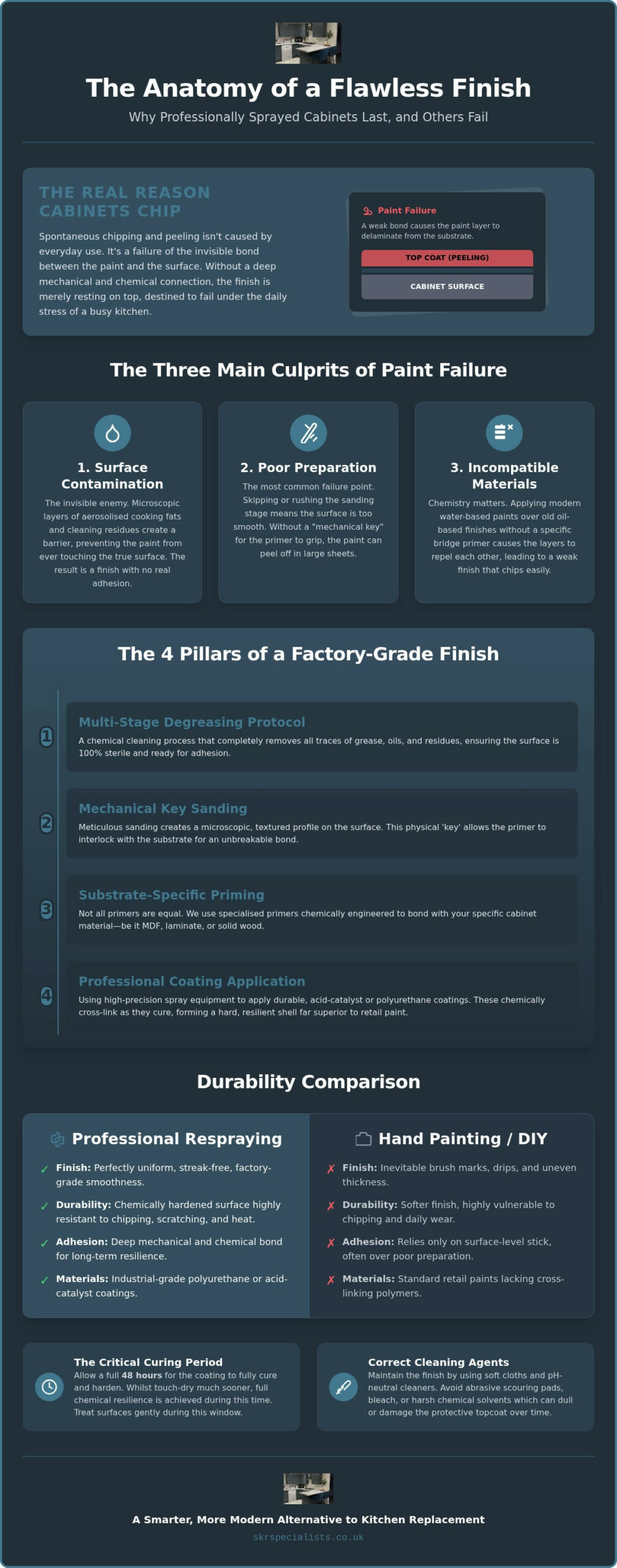
Understanding why do spray painted cabinets chip requires a look at the physics of the kitchen. A chip isn’t always the result of a heavy impact. Whilst a dropped saucepan will dent almost any surface—often requiring a specialist like DovRepairs to restore the finish—spontaneous peeling or flaking indicates a deeper issue with the original application. In a high-traffic kitchen, doors are handled hundreds of times a week, exposed to varying temperatures and constant humidity. Without a professional-grade bond, the finish simply cannot withstand this daily stress.
Standard retail paints are designed for ease of DIY use, not industrial durability. These products often lack the cross-linking polymers found in professional acid-catalyst or polyurethane coatings. Without these chemical bonds, the paint remains relatively soft. It becomes vulnerable to the steam from kettles or the heat from ovens, which eventually compromises the finish. Understanding the fundamental reasons for paint failure is essential for any homeowner looking to avoid a regretful investment.
Poor Surface Preparation: The Number One Cause
When homeowners ask why do spray painted cabinets chip, the answer is almost always found in the preparation stage. Professional finishers know that the vast majority of the work happens before the spray gun is even touched. Kitchens are unique environments because they are often coated in a microscopic layer of aerosolised cooking fats and household cleaning residues. This is the invisible enemy. Even the most expensive paint cannot bond to grease. If this layer isn’t chemically removed through a multi-stage degreasing process, the paint simply sits on top rather than becoming part of the surface.
Sanding is equally non-negotiable. It creates a mechanical key, a physical texture that allows the primer to grip the substrate. When this step is rushed or skipped, it leads to sheet peeling. This is where the paint loses its grip and can be lifted off in large, rubbery strips because it never actually bonded to the material underneath.
Incompatible Materials and Substrates
The material of your cupboards dictates the chemistry of the paint required. Substrates like MDF, laminate, and solid wood all react differently to moisture and temperature. A common mistake in low-quality trade jobs is applying modern water-based paints over old oil-based finishes without a dedicated bridge primer. These two chemistries naturally repel each other, leading to a finish that looks good for a week but chips at the slightest touch.
We often see the failure of all-in-one products. These retail solutions claim to prime and paint in a single coat, but they rarely provide the specialised adhesion needed for non-porous surfaces like laminate. A professional respray uses specific primers designed for the exact substrate of your kitchen, ensuring the finish is locked down for the long term. This targeted approach is what separates a temporary facelift from a factory-quality transformation.
The Science of Adhesion: Why Preparation Prevents Paint Failure
Achieving a factory finish isn’t about the topcoat alone. It’s about engineering a bond that survives the kitchen environment. Adhesion is the molecular bond between the coating and the substrate. Without this, the paint is merely resting on the surface, waiting for a temperature shift or a minor knock to dislodge it. When homeowners ask why do spray painted cabinets chip, the answer usually lies in a failure of either mechanical or chemical adhesion. Mechanical adhesion occurs when the paint physically interlocks with the texture of the surface, whilst chemical adhesion relies on the attraction between molecules in the paint and the cabinet material.
Research into The Science of Paint Failure highlights that environmental factors, particularly moisture and temperature fluctuations, can undermine even the best coatings if the initial bond is weak. In a kitchen, steam and heat are constant. If the paint hasn’t ‘keyed’ into the surface through meticulous sanding, these factors cause the coating to expand and contract at a different rate than the wood or MDF underneath. This internal stress is a primary reason why low-quality finishes eventually fail.
The Degreasing and Cleaning Protocol
A pristine surface is the foundation of durability. Standard household cleaners often leave behind a soapy film that is just as detrimental as the grease they were meant to remove. We use industrial-strength solvent cleaners to strip the substrate back to its raw state. This ensures that the chemical bond is made directly with the cabinet material, not a hidden layer of grime. Skipping this stage is a common mistake in DIY projects, but for a professional, it’s the most critical part of the process. Our kitchen unit respray service treats this preparation as a technical discipline, ensuring every door is chemically ready for its new life.
Specialised Primers and Basecoats
High-build primers do more than just provide a colour base. They act as a flexible buffer. Wood is a living material; it expands and contracts with the humidity of a boiling kettle or a damp winter morning. If a primer is too brittle, it will crack under this movement, leading to the flaking so many property owners dread. Matching the primer’s flexibility to the natural behaviour of the wood is a hallmark of the expert craftsman. Additionally, specialised stain-blocking primers are essential for preventing tannins in woods like oak from bleeding through and discolouring your new finish. Truly understanding why do spray painted cabinets chip helps you spot the difference between a ‘quick fix’ and a professional restoration that lasts for a decade.
This level of dedication to quality is shared by reputable firms like 1st Class Painting & Restoration, who specialise in professional painting and restoration services designed to withstand the test of time.
Professional Respraying vs. DIY Hand-Painting: A Durability Comparison
Hand-painting is often marketed as a simple weekend project for the budget-conscious homeowner. However, the physical structure of a hand-applied finish is inherently weaker than a professional spray. Brushes and rollers leave behind microscopic ridges and valleys known as stippling. These uneven thicknesses are exactly why do spray painted cabinets chip more frequently; the thinner sections act as natural stress points where the paint layer can easily fracture. A professional spray application provides a perfectly uniform micron-thickness across every millimetre of the surface, eliminating these structural vulnerabilities.
Professional equipment allows for the application of high-viscosity coatings that a brush simply cannot handle. Our automotive-inspired approach ensures that every door and drawer front receives a level of precision that mimics an original factory finish. This isn’t just about aesthetics. A smooth, flat surface is harder to catch and gouge, making it significantly more resilient to the daily knocks and scrapes of a busy family kitchen.
Factory Finish vs. Domestic Paint
The gap between retail emulsions and professional acid-catalyst lacquers is vast. Standard trade paints are designed for general domestic use, whereas we utilise industrial coatings that undergo a specific chemical hardening process. This results in a finish that is significantly harder and more scratch-resistant than anything found on a DIY shop shelf. Many property owners ask, is kitchen cabinet spraying durable? The answer lies in this chemical transition. Once cured, these professional coatings provide a resilient shield that mirrors the quality of high-end, newly manufactured cabinetry.
The Risk of ‘Soft’ Finishes
A major drawback of hand-painting is the ‘soft’ finish. Domestic paints can take weeks to fully cure. During this time, they often remain slightly tacky, attracting dust and becoming prone to ‘blocking’ where doors stick to the frames. These soft layers are easily gouged by fingernails, jewellery, or kitchen utensils. Professional spraying utilises rapid-dry technology. Our coatings reach full structural hardness much faster than air-dried paints. This speed is a hallmark of the expert craftsman, ensuring your kitchen is ready for use without the fear of immediate damage. Understanding why do spray painted cabinets chip often comes down to the hardness of the final layer. An industrial finish behaves like a factory-applied laminate, whereas hand-painted surfaces remain vulnerable domestic coatings.
How to Maintain Your Resprayed Kitchen for Long-Term Resilience
A professional respray provides a durable, factory-quality shield, but the days immediately following the application are vital for its longevity. Whilst the surface may feel dry to the touch within hours, the chemical hardening process, known as curing, continues for several days. If you’ve ever wondered why do spray painted cabinets chip shortly after a renovation, the culprit is often premature heavy use. We recommend avoiding any cleaning or heavy contact for the first 48 hours to allow the molecular bonds to reach their full structural integrity. Treating your kitchen with care during this window ensures the finish remains resilient for years to forget.
Safe Cleaning Practices
Maintaining the lustre of your new finish doesn’t require specialised chemicals. In fact, aggressive retail cleaners are often the enemy of a painted surface. Microfibre cloths and mild, soapy water are the most effective tools for daily maintenance. You should strictly avoid ‘magic erasers’ or green scouring pads. These products are essentially fine abrasives that slowly sand away the top layer of the coating, eventually leading to a dull finish that is far more susceptible to damage. If a spill occurs, dry it immediately. Allowing moisture to sit on joins or edges can eventually lead to ingress, which is a common reason for the paint to lose its grip over time.
Managing the Kitchen Environment
The modern kitchen is an environment of extreme temperature shifts. Managing heat and steam is essential for preventing the expansion and contraction that can stress a paint bond. We advise clients to ensure their extractor fans are used whenever the hob is active to reduce the build-up of airborne grease and moisture. A simple but effective tip is to reposition your kettle and toaster. When placed directly under wall cabinets, the concentrated steam and heat can eventually soften the finish, making it vulnerable to peeling. If you are debating between different renovation methods, you might find our guide on kitchen spray painting vs wrapping helpful for understanding which surface holds up better against these environmental factors.
Minor impacts are inevitable in a busy home. If you notice a small nick from a heavy pot, don’t ignore it. A tiny break in the surface can allow moisture or oils to get underneath the paint layer. Addressing these small marks early prevents them from developing into larger issues. By following these simple maintenance steps, you protect your investment and maintain that ‘just-sprayed’ aesthetic. If you’re ready to upgrade your space with a finish designed to last, you can book your professional kitchen unit respray and experience the difference of an expert craftsman’s touch.
Achieving a Factory-Grade Finish with SKR Specialists
SKR Specialists operates at the intersection of technical precision and aesthetic renewal. We don’t just paint cupboards; we restore surfaces using a methodology refined in the high-stakes world of automotive finishing. This background is what sets us apart from general trade practitioners. Whilst a standard decorator might use retail-grade materials, we utilise industrial-strength coatings designed for maximum durability. We have spent years perfecting a system that addresses exactly why do spray painted cabinets chip in lesser applications: a lack of industrial-grade bonding and insufficient surface preparation.
Our approach is a direct challenge to the traditional home improvement industry. We openly question the necessity of full kitchen replacements, positioning our specialised respraying service as the smarter, more modern choice for discerning property owners. By focusing on surface restoration rather than structural demolition, we provide a high-end result that is both cost-effective and remarkably durable. Every project we undertake is backed by quiet confidence and a commitment to meticulous craftsmanship.
The SKR Technical Edge
Our background in high-precision technical trades translates to a level of detail that standard domestic services simply cannot match. We use specialised professional coatings, such as acid-catalyst lacquers, which provide a significantly harder finish than standard household paints. These industrial materials create a cross-linked chemical bond that is incredibly resistant to the scratches, steam, and impacts of a busy family home. By choosing an expert craftsman over a general painter, you ensure that your kitchen’s transformation isn’t just a temporary facelift, but a long-term upgrade designed to withstand the rigours of modern life.
Ready for a Transformation?
The transition from an aged, worn surface to a flawless, factory-quality finish is faster and more seamless than you might imagine. We have designed our service to be as efficient as possible, often completing full kitchen transformations in just a few days. This modern approach avoids the massive disruption and environmental waste of a full structural remodel. If you are looking for a comprehensive deep-dive into the process, our ultimate guide to kitchen resprays provides everything you need to know about professional restoration.
We invite property owners to take the first step towards a smarter kitchen renewal today. By providing digital photos of your current cabinetry through our website, you can receive an immediate, transparent quote. This digital-first approach mirrors our commitment to modern efficiency and expert precision. Don’t settle for a finish that leaves you wondering why do spray painted cabinets chip after only a few months. Choose a partner who values punctuality, meticulous preparation, and a superlative final result. Let us show you the transformative power of a professional respray.
Secure a Flawless Finish for Your Kitchen
Understanding why do spray painted cabinets chip is the first step toward achieving a truly resilient home. It isn’t just about the colour; it’s about the technical bond created through meticulous preparation and industrial-grade coatings. By choosing a factory-quality finish over a standard domestic paint job, you eliminate the structural weaknesses that lead to peeling and flaking. Our expert craftsmen utilise automotive-grade technical backgrounds to ensure every surface is restored with high-precision results.
We provide a cost-effective alternative to full kitchen replacement that far outperforms domestic hand-painting in both durability and aesthetic value. You don’t have to settle for a finish that degrades with daily use whilst a smarter, more modern solution is available. Ready to renew your space with a superlative finish? Get a professional kitchen respray quote today and experience the relief of a flawless, expert transformation. Your dream kitchen is closer than you think.
Frequently Asked Questions
Can I fix spray painted cabinets that are already chipping?
You can repair minor nicks with touch-up kits, but widespread chipping suggests a total bond failure. If the underlying cause is poor preparation, the only long-term solution is to strip the surface and start again. A professional respray involves removing the failed coating to establish a fresh mechanical bond. This ensures the new finish doesn’t just sit on top of the old, unstable layer, preventing the cycle of frustration from repeating.
Is it normal for professionally spray painted cabinets to chip?
Spontaneous chipping should not occur with a high-quality professional finish. Whilst no surface is entirely immune to heavy impact damage, a professional application uses industrial lacquers that bond molecularly to the substrate. If you’re wondering why do spray painted cabinets chip after a professional job, it’s often because the contractor used standard domestic paints rather than specialised industrial coatings. True factory-quality finishes are designed to resist flaking even in high-traffic environments.
How long should a professional kitchen respray last before showing wear?
A high-quality professional respray should last at least 8 to 10 years with standard maintenance. The longevity of the finish depends on the precision of the initial preparation and the quality of the coatings used. Unlike hand-painted surfaces that may show wear within months, industrial finishes are engineered for the rigours of a kitchen. They maintain their structural integrity against heat and moisture, providing a durable alternative to the expense of a full replacement.
What is the best paint to use to prevent cabinets from chipping?
Industrial acid-catalyst lacquers and polyurethane coatings are the most effective at preventing chips. These professional-grade products differ from retail emulsions because they undergo a chemical cross-linking process during curing. This creates a much harder, more resilient surface that resists scratches and impacts. Using these specialised coatings is a hallmark of the expert craftsman, ensuring your kitchen transformation remains flawless whilst avoiding the common pitfalls associated with DIY or general trade paints.
Does the material of my cabinet (MDF vs Wood) affect how easily the paint chips?
Substrates like MDF and solid wood react differently to environmental stress, but both can be chip-resistant with the right primer. MDF is exceptionally stable, making it an ideal surface for spraying. Solid wood expands and contracts with humidity, requiring a flexible primer to prevent the coating from cracking. By matching the primer chemistry to the specific material of your cupboards, we ensure a durable bond that prevents the paint from losing its grip over time.
Will steam from my kettle cause my cupboard paint to peel or chip?
Concentrated steam can eventually undermine standard paints, but industrial coatings are designed to be moisture-resistant. Whilst it is best practice to keep kettles away from the underside of wall units, a professional respray shouldn’t fail due to occasional steam exposure. The failure usually happens when moisture gets behind a poorly bonded edge. High-precision application ensures every join is sealed, protecting the substrate from the humidity and heat typical of a busy UK kitchen.
Is a matte or gloss finish more resistant to chipping?
The sheen level, whether matte or gloss, does not affect the inherent chip resistance of the coating. Durability is determined by the resin technology and the quality of the bond to the cabinet. Whilst gloss finishes might make surface scratches more visible under certain lighting, the actual resistance to chipping remains the same across all sheens when using industrial lacquers. The choice between matte and gloss should be based on your aesthetic preference rather than durability concerns.
How can I tell if a respray company uses high-quality, chip-resistant paint?
Look for specialists with technical backgrounds in high-precision trades, such as automotive finishing. Ask whether they use industrial acid-catalyst coatings or standard retail paints. A professional company will be transparent about their multi-stage degreasing and sanding protocols. If they lead with their technical expertise and expert craftsman approach rather than just low prices, it’s a strong indicator they provide the factory-quality finish required to ensure your kitchen cabinets don’t chip or peel.